

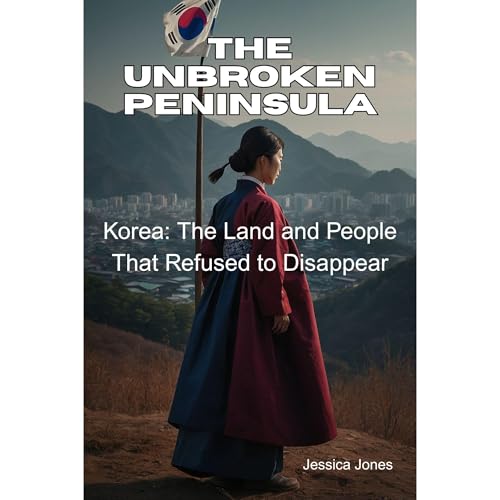
The Unbroken Peninsual
Korea: The Land and People That Refused to Disappear
No se pudo agregar al carrito
Add to Cart failed.
Error al Agregar a Lista de Deseos.
Error al eliminar de la lista de deseos.
Error al añadir a tu biblioteca
Error al seguir el podcast
Error al dejar de seguir el podcast

The Unbroken Peninsual
Compra ahora por $14.99
-
Narrado por:
-
Virtual Voice
-
De:
-
Jessica Jones

Este título utiliza narración de voz virtual
Korea’s history is often summarized by invasion, occupation, and division. But those moments alone do not explain how a nation repeatedly pushed to the edge of erasure continues to stand—rooted in memory, culture, and identity.
This book tells the longer story.
Spanning from Korea’s earliest foundations to its modern global presence, this work traces the pivotal moments that permanently reshaped the peninsula. It is not a military chronicle or a political manifesto. Instead, it is a human history—one that focuses on endurance, adaptation, and continuity across centuries of pressure.
Through the rise and fall of kingdoms, Korea learned early how to survive between greater powers. Repeated invasions tested not only borders, but identity itself. Language, tradition, and collective memory became acts of quiet resistance. Even when sovereignty was lost, culture endured—preserved in households, stories, and daily life.
The Japanese occupation sought to dismantle Korea at its core, banning language and attempting cultural erasure. Liberation came, but it did not bring peace. Division replaced occupation, and war reduced the land to ruins. Families were separated. Cities were destroyed. The scars remain visible today.
Yet survival did not end with war.
Against overwhelming odds, Korea rebuilt—through education, discipline, and collective effort. Democracy was not handed down, but demanded. Economic growth was not guaranteed, but earned through scarcity, urgency, and resilience. Each stage carried forward lessons forged in hardship.
The final chapters explore Korea’s modern presence on the global stage. Film, television, music, food, and technology now reach audiences worldwide—not as novelty, but as expressions of a culture that survived long enough to speak on its own terms. What the world recognizes today as influence is rooted in centuries of endurance.
Written with empathy and clarity, this book avoids academic distance and political debate. It explains significance rather than overwhelming readers with dates. Each chapter stands as a turning point—showing not only what happened, but how it changed the direction of the nation.
This is a story of survival without romanticism, strength without spectacle, and resilience without denial of loss.
Scarred, divided, and still standing, Korea’s history reminds us that endurance is not passive—and that identity, once preserved, can outlast even the most determined attempts to erase it.