

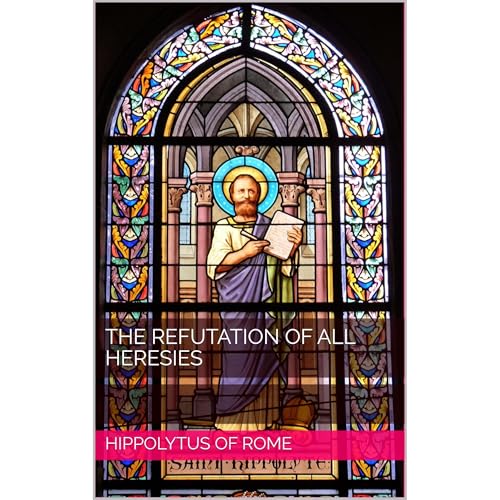
The Refutation of All Heresies
No se pudo agregar al carrito
Add to Cart failed.
Error al Agregar a Lista de Deseos.
Error al eliminar de la lista de deseos.
Error al añadir a tu biblioteca
Error al seguir el podcast
Error al dejar de seguir el podcast
Prueba gratis de 30 días de Audible Standard

The Refutation of All Heresies
Compra ahora por $9.99
-
Narrado por:
-
Virtual Voice

Este título utiliza narración de voz virtual
A Major Source for Understanding Early Christian Heresy and Doctrine
One of the most ambitious polemical works of the early third century, examining the philosophical and religious origins of Christian error and defending apostolic teaching.
• Extensive analysis of Greek philosophy, mystery religions, and early Christian sects
• Essential primary source for the study of Gnosticism, Marcionism, and early heresiology
• Careful, consistent treatment of philosophical and theological terminology
The Refutation of All Heresies, long associated with Hippolytus of Rome and formerly known as Philosophumena, occupies a unique place in early Christian literature. No other surviving work offers such a broad and sustained attempt to trace contemporary heresies back to their philosophical and religious predecessors.
Although earlier scholarship confidently attributed the work to Hippolytus—and still earlier to Origen—most modern scholars regard its author as an otherwise unknown Roman theologian writing in the early third century. This edition reflects that scholarly consensus while retaining the traditional attribution for historical continuity and reader familiarity.
The text is valuable not only for its doctrinal polemic, but also for its detailed preservation of ancient philosophical systems and religious practices. As such, it serves historians of Greco-Roman thought and religion as well as students of Christian theology.
This modernized edition emphasizes accuracy, clarity, and consistency. The translation has been carefully checked, terminology standardized, and the structure of the original respected, resulting in a reliable English presentation suitable for academic courses, clergy, and serious readers of patristic literature.
This revision was prepared through an AI-assisted process, combining digital tools with traditional editorial work.