

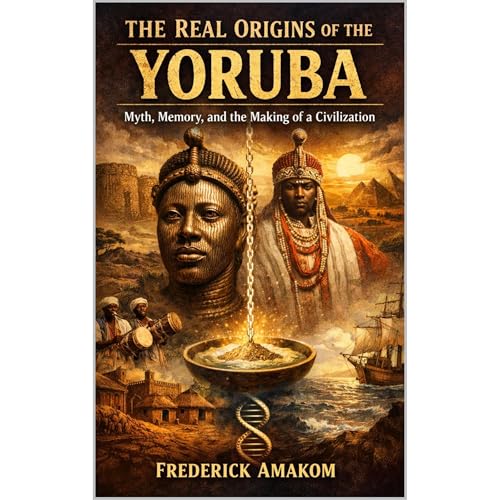
The Real Origins of the Yoruba: Myth, Memory, and the Making of a Civilization
No se pudo agregar al carrito
Add to Cart failed.
Error al Agregar a Lista de Deseos.
Error al eliminar de la lista de deseos.
Error al añadir a tu biblioteca
Error al seguir el podcast
Error al dejar de seguir el podcast

The Real Origins of the Yoruba: Myth, Memory, and the Making of a Civilization
Compra ahora por $9.00
-
Narrado por:
-
Virtual Voice
-
De:
-
Frederick Amakom

Este título utiliza narración de voz virtual
Did the Yoruba people descend from heaven through Oduduwa?
For centuries, Yoruba oral tradition has told of a sacred descent — a chain from the sky, sand scattered upon primordial waters, and the founding of Ile-Ife, the spiritual cradle of a civilization.
But what does archaeology say?
What does linguistics reveal?
What does DNA research confirm?
In The Real Origins of the Yoruba, Frederick Amakom brings together oral history, Ifa philosophy, political systems, archaeology, colonial historiography, and modern genetic science to answer one of Africa’s most important civilizational questions.
This book explores:
- The sacred narrative of Oduduwa and its cosmological meaning
- The bronze civilization of Ile-Ife and its archaeological evidence
- The rise and political sophistication of the Oyo Empire
- Internal Yoruba variations in origin traditions
- The impact of Christianity, Islam, and colonial documentation
- Genetic research and what it truly says about Yoruba ancestry
- The survival of Yoruba identity across the Atlantic in Brazil and Cuba
- The modern political and cultural revival of Oduduwa’s legacy
This is not an attack on tradition. It is not a dismissal of faith. It is a balanced, research-based examination of how myth and history coexist. The conclusion is clear:
The Yoruba are deeply indigenous to West Africa.
Their civilization developed through time — not foreign transplantation.
Their achievements stand independently.
Bold yet respectful, scholarly yet accessible, this book offers clarity where confusion has lingered.
For readers of African history, Nigerian politics, cultural identity, and indigenous knowledge systems, this is a necessary work.
A civilization does not need to descend from heaven to stand tall.
The Yoruba stand on their own foundations.