

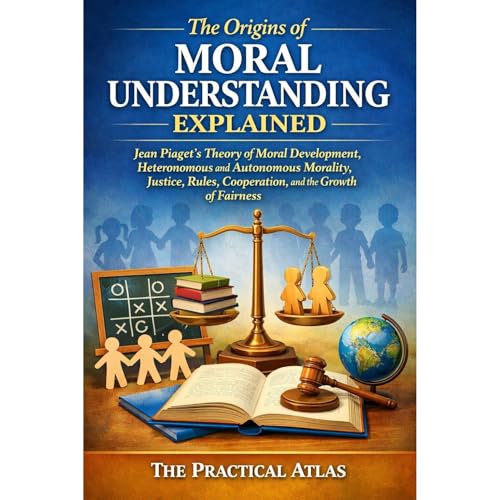
The Origins of Moral Understanding Explained
Jean Piaget’s Theory of Moral Development, Heteronomous and Autonomous Morality, Justice, Rules, Cooperation, and the Growth of Fairness
No se pudo agregar al carrito
Add to Cart failed.
Error al Agregar a Lista de Deseos.
Error al eliminar de la lista de deseos.
Error al añadir a tu biblioteca
Error al seguir el podcast
Error al dejar de seguir el podcast
Obtén 30 días de Standard gratis

The Origins of Moral Understanding Explained
Compra ahora por $3.99
-
Narrado por:
-
Virtual Voice

Este título utiliza narración de voz virtual
The Origins of Moral Understanding Explained: Jean Piaget’s Theory of Moral Development, Heteronomous and Autonomous Morality, Justice, Rules, Cooperation, and the Growth of Fairness
What does it really mean for a child to understand fairness? How do children move from blind rule following to thoughtful moral reasoning grounded in justice and cooperation? In The Origins of Moral Understanding Explained, The Practical Atlas offers a deep and accessible exploration of Jean Piaget’s groundbreaking theory of moral development. This book examines how children construct their understanding of rules, responsibility, equality, and intention, and why peer relationships play a decisive role in the growth of autonomous morality.
Drawing on Piaget’s classic research into heteronomous and autonomous morality, this comprehensive guide walks readers through the stages of moral development in detail. You will discover how young children interpret rules as fixed and sacred, why they focus on consequences rather than intentions, and how cooperative play gradually reshapes their understanding of justice. The book explores moral realism, reciprocity, punishment, perspective taking, and the classroom as a moral laboratory, showing how fairness evolves through social interaction rather than simple instruction.
Ideal for educators, parents, psychology students, and lifelong learners, this book bridges theory and real world application. It connects Piaget’s original insights to contemporary research in developmental psychology, moral education, and social cognition. Whether you are interested in child development, educational practice, or the foundations of ethical reasoning, this volume provides a clear and structured deep dive into one of the most influential theories in modern psychology.
If you want to understand how fairness grows from within, how children become moral agents, and how cooperation shapes the development of justice, The Origins of Moral Understanding Explained is your complete guide to Piaget’s enduring contribution to moral psychology.
FROM THE HALF HOUR HELP SERIES OF BOOKS
The Half Hour Help Series is a collection of concise, practical guides designed to teach the basics of a subject or provide quick solutions to everyday problems. Each book is crafted to be read in about 30 minutes, making it ideal for busy readers who want to learn something new or solve a specific issue without wading through lengthy manuals or complex jargon.
Whether you're looking to understand a new concept, develop a skill, or tackle a challenge, these guides break things down into simple, actionable steps.
Focused on clarity and efficiency, the Half Hour Help Series covers a wide range of topics—from personal development and productivity to science and technology, wellness, culture, and beyond.
Every title is built around the idea that a little help can go a long way, and with just half an hour, readers can gain valuable insights and confidence to move forward.
It's smart support when you need it, without the fluff.