

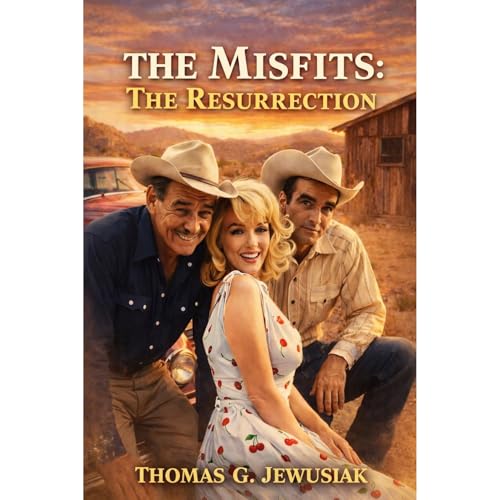
The Misfits: The Resurrection
No se pudo agregar al carrito
Solo puedes tener X títulos en el carrito para realizar el pago.
Add to Cart failed.
Por favor prueba de nuevo más tarde
Error al Agregar a Lista de Deseos.
Por favor prueba de nuevo más tarde
Error al eliminar de la lista de deseos.
Por favor prueba de nuevo más tarde
Error al añadir a tu biblioteca
Por favor intenta de nuevo
Error al seguir el podcast
Intenta nuevamente
Error al dejar de seguir el podcast
Intenta nuevamente
Prueba gratis de 30 días de Audible Standard
Selecciona 1 audiolibro al mes de nuestra colección completa de más de 1 millón de títulos.
Es tuyo mientras seas miembro.
Obtén acceso ilimitado a los podcasts con mayor demanda.
Plan Standard se renueva automáticamente por $8.99 al mes después de 30 días. Cancela en cualquier momento.

The Misfits: The Resurrection
Narrado por:
Virtual Voice
Compra ahora por $14.99
-
Narrado por:
-
Virtual Voice

Este título utiliza narración de voz virtual
Voz Virtual es una narración generada por computadora para audiolibros..
Written by Arthur Miller and directed by John Huston, The Misfits was originally conceived as a vehicle for Marilyn Monroe, Miller’s then-wife, whose public persona had already been commodified beyond recognition. The film’s production was famously turbulent: Monroe’s health deteriorated, her marriage to Miller collapsed, and Clark Gable died days after filming wrapped. These real-life fractures seep into the film’s texture, giving it a haunted quality that transcends plot. What unfolds is not a conventional narrative arc but a philosophical reckoning, a meditation on freedom, alienation, and the moral cost of performance.
At the center of this reckoning is Monroe’s Roslyn. Roslyn is written as a woman adrift, recently divorced, emotionally porous, and morally aware. But Monroe’s embodiment of her transcends Miller’s script. She brings to Roslyn not just empathy, but a lived resistance to the symbolic violence of being seen without being understood. Her gestures, hesitations, and gaze are not dramatic flourishes; they are philosophical assertions. She refuses to perform femininity as spectacle. Instead, she performs grief, ethical outrage, and the quiet terror of being misread.
Critics who expected Monroe's "blonde bombshell" persona were met with a raw, emotionally complex character grappling with her fragility. Monroe's performance as Roslyn, her last completed film role, showcased a new dramatic depth that many found unsettling but that is now considered her most compelling work. The actors' public and private struggles were almost too closely mirrored by their characters' pain, creating a sense of voyeuristic unease for audiences.
Roslyn/Marylyn meets three aging men, Gay (Gable), Guido (Eli Wallach), and Perce (Montgomery Clift), the youngest, each clinging to obsolete ideals of masculinity; not because their ideals have collapsed but because the world around them has undermined and corrupted those ideals.
Her emotional transparency, often dismissed as fragility, is in fact a moral stance. She refuses to perform detachment. She weeps for wild horses, recoils from violence, and speaks with a poetic directness that unsettles the film’s rugged male terrain. Roslyn’s ethical clarity destabilizes the film’s ontology. She is not a stable subject within a coherent world; she is a destabilizing force within a collapsing one. Her presence forces the men to confront their own obsolescence, not through argument, but through affect.
In The Misfits, Marilyn Monroe does not merely inhabit the role, she dismantles it. Her portrayal of Roslyn is not a performance in the conventional sense, but a philosophical intervention into the ethics of representation. It is a refusal to be entrapped by the cultural machinery that had long commodified her image, voice, and vulnerability. Roslyn’s presence destabilizes the men’s illusions, not through seduction but through her refusal to play the role they expect. Her empathy, her horror at the capture of wild horses, and her emotional transparency challenge the men’s performative stoicism. Monroe is a study in narrative erasure, a figure whose inner-self was systematically denied by the culture that devoured her. The Misfits as originally written attempted, however imperfectly, to restore that inner-self.
Todavía no hay opiniones