

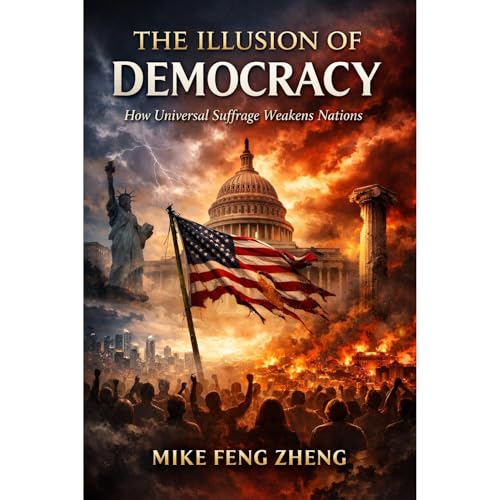
The Illusion of Democracy
How Universal Suffrage Weakens Nations
No se pudo agregar al carrito
Add to Cart failed.
Error al Agregar a Lista de Deseos.
Error al eliminar de la lista de deseos.
Error al añadir a tu biblioteca
Error al seguir el podcast
Error al dejar de seguir el podcast
 Exclusivo para miembros Prime: ¿Nuevo en Audible? Obtén 2 audiolibros gratis con tu prueba.
The Illusion of Democracy
Compra ahora por $7.99
-
Narrado por:
-
Virtual Voice
-
De:
-
Mike Feng Zheng

Este título utiliza narración de voz virtual
What if democracy, as practiced today, is not strengthening nations—but slowly weakening them?
For decades, universal suffrage has been treated as the unquestioned foundation of political legitimacy. After the Cold War, many believed liberal democracy represented the final stage of political evolution. From Washington to Brussels to Tokyo, the prevailing assumption was clear: electoral democracy leads to prosperity, stability, and long-term national success.
But history tells a more complicated story.
In The Illusion of Democracy: How Universal Suffrage Weakens Nations, Mike Feng Zheng challenges one of the most widely accepted assumptions of the modern era. Drawing on historical analysis, political theory, economic data, and civilizational comparisons, this book examines whether universal suffrage—while morally powerful—may contain structural weaknesses that affect governance, fiscal sustainability, and national competitiveness.
Why do many developing democracies struggle with instability, corruption, and policy inconsistency?
Why do electoral cycles increasingly reward political performance over administrative competence?
Why do fiscal pressures, polarization, and short-term populism intensify under modern mass democracy?
This is not an attack on democracy as a principle.
It is a structural examination of how political selection mechanisms operate in complex modern states.
Through comparisons across empires, democratic systems, and rising and declining powers, the book explores:
• The historical evolution of democracy from tool to ideology
• The difference between electoral legitimacy and governance capacity
• The problem of political short-termism in high-complexity economies
• The survivorship bias in judging democratic success
• Whether political systems must evolve alongside technological and economic change
In an age of polarization, institutional erosion, and rising geopolitical competition, asking difficult questions about governance is not radical—it is necessary.
The Illusion of Democracy is a thought-provoking work for readers interested in political philosophy, geopolitics, economic development, institutional reform, and the future of nation-states in the 21st century.
If democracy is not the end of history, what comes next?