

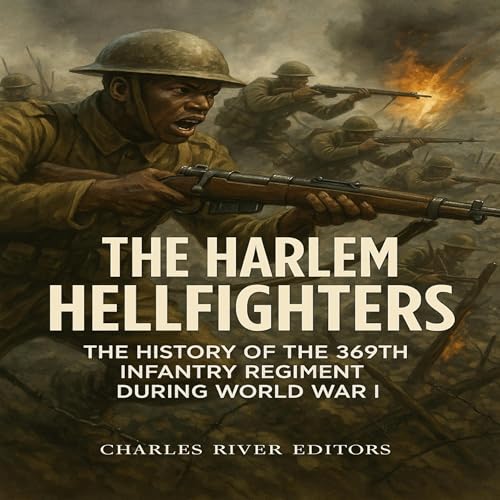
The Harlem Hellfighters
The History of the 369th Infantry Regiment During World War I
No se pudo agregar al carrito
Add to Cart failed.
Error al Agregar a Lista de Deseos.
Error al eliminar de la lista de deseos.
Error al añadir a tu biblioteca
Error al seguir el podcast
Error al dejar de seguir el podcast
Prueba gratis de 30 días de Audible Standard

The Harlem Hellfighters
Compra ahora por $9.76
-
Narrado por:
-
Steve Knupp
The Harlem Hellfighters, also known as the 369th Infantry Regiment of the U.S. Army, embody a significant intersection of America’s military history and racial history. Initially raised as the 15th New York (Colored) National Guard and later federalized for World War I, the regiment was "loaned" to the French Army, where it compiled an extraordinary combat record, with a remarkable 191 days on the line and suffering about 1,400 casualties while never yielding its sector (Morrow & Sammons, 2014, pp. 3–6; Harris, 2003, pp. 233–235). These numbers, often highlighted in museum and official summaries, became a central pillar of the unit’s symbolic influence back home, and the unit’s performance in battle, unique experience under French command, and their triumphant homecoming in 1919 collectively reshaped debates concerning black soldiers’ loyalty, capability, and rights. As Colonel William Hayward famously told journalists, his men “never retire,” a sentiment that both the contemporary press and later unit histories preserved, capturing their combat ethos and the representational burdens they carried as black citizen-soldiers (Harris, 2003, pp. 5–7).
At the same time, of course, their service did not immediately undo Jim Crow back home, even as the formation of the regiment was tied to civil rights efforts. Authorized in 1913 and organized in 1916 as New York’s first black National Guard regiment, the 15th drew volunteers from Harlem and beyond and practiced drills in borrowed spaces due to a lack of a finished armory (Morrow & Sammons, 2014, pp. 97–104; Harris, 2003, pp. 23–31). The regiment’s creation was the product of sustained black civic mobilization in New York and an older tradition of black soldiers that dated to the Civil War. When the United States declared war in April 1917, black leaders and newspapers urged enlistment, often framing service as a path to recognition and citizenship.