Episodios

  • Transposons and epigenetic priming of enhancers within early human embryo development with Dr Christopher Todd
    Apr 13 2022

    In today's episode I spoke again to Dr Christopher Todd from the Babraham institute. Chris is a postdoctoral researcher in Wolf Reiks lab who talked to me about transposable elements and epigenetic priming of enhancers with human embryonic development. Chris gave a great talk at GREECS 2022 where he discussed his research and I absolutely loved his talk, so immediately messaged him to join me on the podcast! 

    If like me, you feel unclear on what exactly are transposable elements, the details of their function & classification and want to learn more about enhancer priming, stay tuned to learn lots! Even if you do know these things, I guarantee you will still learn so much from Chris! Hope you all enjoy!

    Chris' twitter: https://twitter.com/C_D_Todd

    Reik lab twitter: https://twitter.com/ReikLab

    Chris profile on Babraham website: https://www.babraham.ac.uk/people/member/746

    Google scholar: https://scholar.google.com/citations?user=WPqJa6QAAAAJ&hl=en

    Más Menos
    1 h y 27 m
  • Neuroscience meets epigenetics - Doctor Ben Rein
    Feb 18 2022

    TGL made it to 2022! On todays episode, I spoke to Dr Benjamin Rein, a neuroscientist all the way from Stanford.  We speak all about Bens experience of science communication on social media, Ben uses Tik Tok & instagram to make awesome short videos on scientific papers and topics and has gained a following of +600,000 on tik tok! He also talks all about his passion for neuroscience, his PhD research and then we talked a lot about stuff we dont know a lot about! 


    Hope you enjoy this conversation & be sure to check Ben out on social media using the links below!

    Bens tik tok - https://www.tiktok.com/@dr.brein?lang=en

    Bens instagram - https://www.instagram.com/doctor.brein/?hl=en

    Bens website - https://www.benrein.com

    Más Menos
    1 h y 27 m
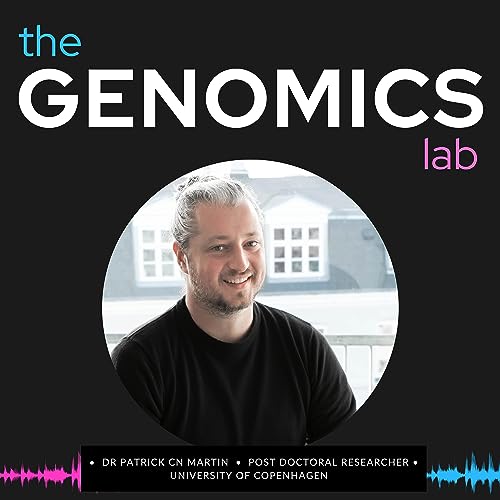
  • Spatial transcriptomics with Dr Patrick CN Martin
    Dec 8 2021

    In today's episode I spoke again to Dr Patrick CN Martin from the Biotech research and innovation centre at the University of Copenhagen, about spatial transcriptomics. Patrick is a post doctoral researcher who has been working on ST and more specifically, this pre print which we also took a deep dive into, on todays episode! Patricks new tool, named Vesalius (stay tuned to find out why) is able to decipher tissue anatomy from ST data by converting transcriptomic information into a color code for image segmentation. 

    The tool is able to successfully detect tissue architecture in mouse embryo and brain from high resolution ST data by incorporating image processing algorithms. Vesalius is a tool to perform high-resolution in silico anatomization and molecular characterization from ST data. 

    If like me, you feel unclear on what exactly is ST and how it works, stay tuned to learn lots! Even if you do know what ST is, don't worry! once Patrick taught me all about ST, we took a deep dive into the pre print, and discussed so many interesting topics.


    Patricks twitter: https://twitter.com/pcnmartin

    The pre print: https://www.biorxiv.org/content/10.1101/2021.08.13.456235v2

    GREECS registration : https://whova.com/portal/registration/early_202201/


    Más Menos
    1 h y 17 m
  • Epigenetics & fertility with Alka Gupta
    Nov 17 2021

    This week I spoke to Alka Gupta. Alka has just finished up her PhD and begun her postdoctoral position at UCSC in the Sharma Lab where she is now working on epigenetic inheritance. Today we spoke about her PhD research in which she was looking at the role of microRNAs in male infertility. We learnt about Sertoli cells, spermatogenesis and shrinking testis! Tune in to find out more!


    Contact Alka here: https://twitter.com/alka_gupta__

    GREECS registration link: https://whova.com/portal/registration/early_202201/

    Más Menos
    1 h y 12 m
  • Biomarkers in genomics with Dr Paul Okunieff
    Oct 27 2021

    Today I speak to Dr Paul Okunieff , founder and consultant of Diacarta. DiaCarta is a leading translational genomics and personalized diagnostics company based in California. DiaCarta provides highly sensitive and advanced technologies aiming to change the landscape of precision medicine and molecular diagnostics by impacting healthcare treatment plans and the well-being of individuals around the world. Today me and Paul chat about the use of biomarkers in genomics, we touch on his recent coauthored papers in nature scientific reports here. We also discuss some ethical issues behind biomarkers and how events like 9/11 led Paul to pursue his career in this field. 

    Please visit Diacartas website here to find out more about them and connect with them on LinkedIn here.

    Más Menos
    55 m
  • The dark matter of the genome with Sudarshan Pinglay
    Oct 6 2021

    On todays episode, I speak to Sudarshan Pinglay, a PhD student from NYU medical center. Sudarshan is involved in the dark matter project- we talk about the dark matter of the genome, where introns, repetitive and regulatory elements reside. Sudarshan works specifically on the HOXA locus. The Hox family of genes pattern the head to tail axis in the developing embryo. In mammals, there are are four separate clusters (HoxA,B,C and D). Both space and time of Hox gene expression is colinear to their sequence in the genome. Loss of this leads to serious defects. 

    Sudarshan talks about his wet lab and dry lab work, where he has been using the HoxA cluster as a model to understand how the expression of Hox genes is regulated in order to pattern the developing nervous system. He tells us about his work aiming to build the HoxA cluster from the ground up so that he could manipulate the various players that have been implicated in Hox gene regulation and understand the pattern of Hox gene expression and embryonic development.

    This is the pre print we discussed in todays episode, and more on the dark matter genome project can be found here.

    Sudarshan can be found on twitter here!

    Más Menos
    1 h y 9 m
  • The immune system: B cells and Epigenetics with Dr Hamish King
    Sep 22 2021

    In todays episode, I speak to Dr Hamish King, a Sir Henry Wellcome Fellow affiliated with the Blizard Institute at Queen Mary University of London. Hamish is interested in how errors in gene regulation lead to changes in the behaviour and function of B cells, an important cell type in our immune system that makes antibodies to fight and remember infections. Hamish talks about how he uses wet lab and bioinformatic techniques to answer these questions. Dr King is also due to become a laboratory head at WEHI in early 2022, where his lab will focus on answering a range of questions including:

    1. How immune-specific chromatin-based mechanisms regulate gene expression
    2. Whether autoimmune-associated genetic risk loci disrupt regulatory function of enhancers
    3. If disease-specific epigenomic networks exist in autoimmunity

    We talk also in the episode, about Hamish's recent paper which is accessible here, you can also find Hamish on twitter here where he is happy to be contacted further about his research and upcoming vacancies in his brand new lab. 

    Más Menos
    1 h y 15 m
  • Epigenetic biomarkers of exposure to tobacco smoke : A biosocial approach with Alexandria Andrayas
    Sep 8 2021

    Welcome to Episode 29 of The Genomics Lab! On today's episode we talk to Alexandria Andrayas who is a PhD candidate in the Soc-B Centre for doctoral training which is a new and unique programme in biosocial research. The programme is funded by the Economic and Social Research Council and the Biotechnology & Biological Sciences Research Council. It combines the strengths of the University of Essex, Manchester and UCL. The impact of smoking on health can be mediated through several biological pathways and it is well documented that smoking can be linked to large differences in DNA methylation as Alex discusses today. We also discuss the need and importance of giving consideration to the role that society may play in studies such as these. Stay tuned to find out more about epigenetics, DNA methylation and biosocial research.

    Contact alex here: https://www.iser.essex.ac.uk/people/aandra

    My preprint: https://www.biorxiv.org/content/10.1101/2021.09.02.458717v1

    Más Menos
    1 h y 2 m