

THE INFLUENCE OF THE KABBALA ON JEWISH THEOLOGY
No se pudo agregar al carrito
Add to Cart failed.
Error al Agregar a Lista de Deseos.
Error al eliminar de la lista de deseos.
Error al añadir a tu biblioteca
Error al seguir el podcast
Error al dejar de seguir el podcast
Prueba gratis de 30 días de Audible Standard

THE INFLUENCE OF THE KABBALA ON JEWISH THEOLOGY
Compra ahora por $3.99
-
Narrado por:
-
Virtual Voice

Este título utiliza narración de voz virtual
This book argues that Kabbalah isn’t a decorative “occult appendix” to Judaism, but one of the major Jewish languages for talking about God, creation, prayer, exile/redemption, and the inner meaning of mitzvot—and that its influence is best measured not by how many people read the Zohar, but by how deeply kabbalistic assumptions seeped into ordinary Jewish devotion, custom, and theological instinct.
It frames Jewish theology as operating through three overlapping “grammars”: rabbinic/halakhic (practice and law), philosophical (especially the Maimonidean attempt at disciplined divine unity/transcendence), and mystical (Kabbalah’s symbolic languages and spiritual “mechanics”). From there, it tells the origin story as a river system: earlier tributaries (Merkabah/Heikhalot throne–palace mysticism and Ezekiel imagery, plus Sefer Yetzirah letter/number cosmology) feed into a distinct medieval movement that crystallizes in Provence/Catalonia and then explodes in Spain through the Bahir and especially the Zohar tradition.
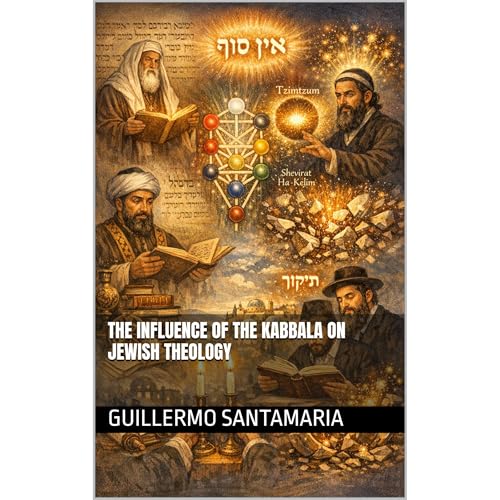
The timeline section is the book’s spine: medieval emergence (12th–13th centuries), then the 16th-century Safed “shockwave” (especially Isaac Luria) which reframes reality through tzimtzum/shevirah/tikkun and pushes Kabbalah toward broader communal life, followed by the 17th–18th century spread into popular religion—sometimes fruitful, sometimes volatile—culminating in Hasidism as a democratized, devotionalized “Kabbalah for the masses.” The book repeatedly stresses that influence isn’t uniform: some communities absorb kabbalistic motifs as default piety; others resist, gatekeep, or reinterpret them.
It then gets concrete about where Kabbalah reshaped religious life: it changes how Jews “talk monotheism” (Ein Sof plus emanational language as a way to speak of transcendence and presence without collapsing divine unity), it alters liturgy and minhag (Kabbalat Shabbat, Tikkun Leil Shavuot), it normalizes doctrines like gilgul in popular imagination, and it sometimes pressures halakhic practice through minhag even when not formally legislated.
A major clarifying move is the book’s threefold typology: theosophical-theurgic Kabbalah (Zoharic/Lurianic “God-and-world map” plus the claim that worship/mitzvot participate in supernal harmony), ecstatic/prophetic Kabbalah (Abulafia-style letter and Name meditation aimed at altered states/prophetic experience), and practical Kabbalah (amulets/divine names—persistently present but repeatedly policed). This distinction helps explain why “Kabbalah” can look like metaphysics in one chapter, a meditative method in another, and a boundary-problem in another.
The book also leans into conflict, not as a side drama but as a built-in feature: the Maimonidean/philosophy vs. mysticism tension (how to protect divine unity and avoid superstition or anthropomorphism), later flare-ups over authority and textual legitimacy, and then the “dark mirror” of Sabbateanism and Frankism—where messianic-mystical energy becomes destabilizing and forces Jewish communities to re-tighten boundaries around charismatic religion and esotericism.
On prayer, it explains the shift from basic halakhic kavanah (meaningful intention) into kabbalistic kavanot and yichudim (structured intentions and “unifications”), framing this as a redefinition of intention from sincerity to participation—prayer as something that, in kabbalistic grammar, does work in the divine economy..