

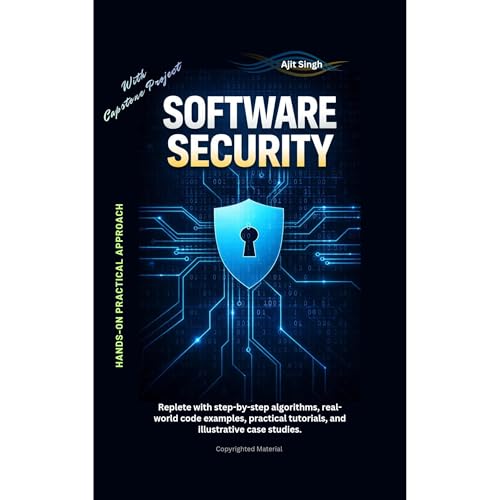
Software Security
No se pudo agregar al carrito
Solo puedes tener X títulos en el carrito para realizar el pago.
Add to Cart failed.
Por favor prueba de nuevo más tarde
Error al Agregar a Lista de Deseos.
Por favor prueba de nuevo más tarde
Error al eliminar de la lista de deseos.
Por favor prueba de nuevo más tarde
Error al añadir a tu biblioteca
Por favor intenta de nuevo
Error al seguir el podcast
Intenta nuevamente
Error al dejar de seguir el podcast
Intenta nuevamente
Obtén 30 días de Standard gratis
$8.99 al mes después de que termine la prueba. Cancela en cualquier momento

Software Security
Narrado por:
Virtual Voice
Compra ahora por $6.40
-
Narrado por:
-
Virtual Voice
-
De:
-
Ajit Singh

Este título utiliza narración de voz virtual
Voz Virtual es una narración generada por computadora para audiolibros..
Philosophy: Security as an Engineering Discipline
The foundational philosophy of this book is that software security is not an audit, a checklist, or a final gate; it is a fundamental aspect of quality software engineering. The core philosophy of this book is that security is a development discipline, not a separate function. It is a shared responsibility of every developer, architect, and tester. This book rejects the outdated model of "penetrate and patch" and instead champions a proactive "build security in" approach. I believe that the most effective way to learn is by doing, and therefore, every concept is tied to a tangible action, a piece of code, or a practical development task. I focused on pragmatic, evidence-based practices that can be integrated directly into the daily workflow of a development team, making security a seamless and integral part of the entire Software Development Lifecycle (SDLC).
Key Features
1. Capstone Project-Driven: The book culminates in a full-fledged DIY capstone project where students build a secure web application, integrating lessons from every preceding chapter.
2. OWASP Top 10 Focus: A dedicated chapter provides an in-depth, practical exploration of the OWASP Top 10 vulnerabilities, which serves as a cornerstone of modern application security.
3. DevSecOps Integration: The book addresses contemporary development practices, explaining how security activities are integrated into CI/CD pipelines and agile workflows.
4. Simple and Clear Language: We intentionally avoid dense academic jargon where possible, opting for clear, direct explanations that are easy for students to understand and retain.
5. Beginner to Advanced: While the book starts with the basics, it progressively introduces more advanced topics like secure architecture patterns and automated security testing, making it a valuable resource for both introductory and advanced courses.
Key Takeaways
1. Upon completing this book, the reader will be able to:
2. Understand the Security Mindset: Think like an attacker to identify potential weaknesses in software.
3. Design Secure Software: Apply principles like Threat Modeling and secure design patterns to architect resilient applications.
4. Write Secure Code: Identify and prevent common vulnerabilities such as SQL Injection, Cross-Site Scripting (XSS), and Insecure Deserialization.
5. Test for Vulnerabilities: Utilize both static (SAST) and dynamic (DAST) analysis tools to discover security flaws in code and running applications.
6. Integrate Security into DevOps: Understand how to embed automated security checks and practices into a modern CI/CD pipeline.
7. Build a Complete Secure Application: Apply all learned concepts to successfully complete a capstone project, demonstrating end-to-end software security skills.
Disclaimer: Earnest request from the Author.
Kindly go through the table of contents and refer kindle edition for a glance on the related contents.
Thank you for your kind consideration!
adbl_web_anon_alc_button_suppression_t1
Todavía no hay opiniones