

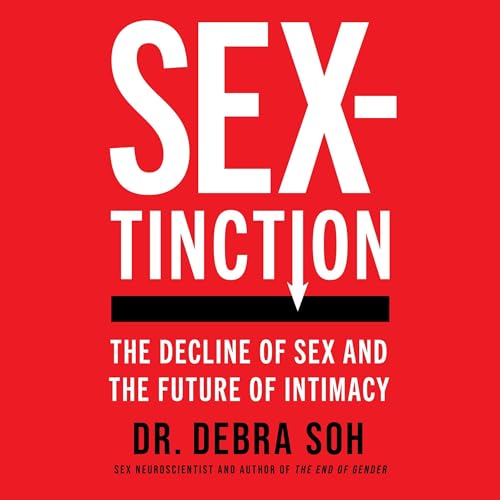
Sextinction
The Decline of Sex and the Future of Intimacy
No se pudo agregar al carrito
Solo puedes tener X títulos en el carrito para realizar el pago.
Add to Cart failed.
Por favor prueba de nuevo más tarde
Error al Agregar a Lista de Deseos.
Por favor prueba de nuevo más tarde
Error al eliminar de la lista de deseos.
Por favor prueba de nuevo más tarde
Error al añadir a tu biblioteca
Por favor intenta de nuevo
Error al seguir el podcast
Intenta nuevamente
Error al dejar de seguir el podcast
Intenta nuevamente
Obtén 30 días de Standard gratis
$8.99 al mes después de que termine la prueba. Cancela en cualquier momento

Sextinction
Narrado por:
Debra Soh
Compra ahora por $18.74
-
Narrado por:
-
Debra Soh
-
De:
-
Debra Soh
There’s a strange paradox in today’s developed world: society has never been more sexualized, but people across all age groups and demographics are having less sex than ever before. And nobody seems to know why or what to do about it.
The “fearless” (Eric R Weinstein, PhD, host of The Portal) Dr. Debra Soh leaves no stone unturned as she searches for science-backed answers. She takes us on a roller-coaster journey through ideological debates, new technological frontiers, and modern dating to understand the whys and hows of this issue.
With an expert and impartial eye, Soh examines these evolving and controversial developments and colors her findings with anecdotes from her personal research. Compulsively readable and groundbreaking, Sextinction upends the conventional wisdom surrounding sex, skewering pieties held by the right and left alike, and looks to the future of sexuality.
Los oyentes también disfrutaron:




adbl_web_anon_alc_button_suppression_t1
Las personas que vieron esto también vieron:





May 6, 2026
I've seen a lot of people in younger millennial and Gen Z group say they're struggling to find a relationship, so it's hard to dispute the facts and data presented here. In short, Soh does a great job identifying and addressing the decline in sex and relationships, but doesn't fully explore how or why it became as problematic as it currently is today.
With the exception of the chapter about the growth of sex robots, much of what was discussed isn't new or groundbreaking, but it is important to consider the second order effects from the growth in such products and services and how they will impact relationships in the future.
Although it's my opinion, I believe that the contributing factors to this problem stem from a generalized sense of uncertainty, which is a larger issue than politics, gender or identity. Soh made a point about millenials and Gen Z being more coddled than previous generations. I would grant that it's true to an extent, but it doesn't tell the whole story. Millennials, those born between 1981 and 1996 have dealt with more uncertainty and unpredictability compared to previous generations.
To name a few examples:
1) 9/11, which ended a sense of relative stability and safety in the world.
2) 2007-2008 Recession. This was a period where millenials should have been coming into their own both personally and professionally, but were impacted by the recession which negatively affected their job prospects and earning power which delayed adult milestones like getting married or starting a family.
*What's interesting is that there was a mini baby boom from 2005 to 2008 where birth rates significantly increased, but once the recession hit, birth rates fell from 2009 to today, even when economic conditions improved in the 2010s. I would imagine lack of job security played a role in future planning.
3) Covid-19 Pandemic and 2020 in General. The pandemic affected everyone, but those starting to get settled saw an abrupt change to their day-to-day life. Many were isolated or laid off from their jobs. The growth in time spent on social media further eroded a sense of community.
Although Gen Z gets a lot of flak, they've also experienced uncertainty in other ways, such as:
1) Being digital natives. This generation doesn't know a world without internet or social media. This generation is inundated with all the world's problems all at once through social media, and they have 24/7 access to doom scrolling if they want to. They're also exposed to the culture of comparison.
2) Covid-19 Pandemic and 2020. Many found themselves isolated during formative years for developing social skills and emotional intelligence. It further exacerbated young people's dependence on devices and distractions.
3) Growth of AI. Many graduating high school have to consider if their career path might get replaced by AI. The true second order effects of AI into the market are still unknown which only fuels more uncertainty about making future plans.
4) Rising inflation. No secret that the cost of good and services have risen to all-time highs since 2020. This makes the effort of wanting to date that much harder. If young people are struggling financially, they will be less focused on long-term planning. The cost of wages have not kept up with inflation.
Regardless of one's stance on politics or society, people who don't feel a sense of security or well-being about the future are less likely to want to invest in it. This has caused people to become more self-focused and only concern themselves with self-preservation, but survival skills aren't growth skills.
The brain itself evolved to take short cuts. When we take mental shortcuts, it is our brain's way of conserving energy. The short cuts are only focused on immediate gratification, and when people are already burned out, they will take the path of least resistance mentally (Social media companies have capitalized on this research). So, when there is an abundance of distractions that satisfy people's needs that predictable, they are going to seem more appealing than dealing with risk and uncertainty, but that doesn't mean that this type of coping is healthy or sustainable in the long-term.
Very Good Overall.
Se ha producido un error. Vuelve a intentarlo dentro de unos minutos.
Fumbles at the finish line.
Se ha producido un error. Vuelve a intentarlo dentro de unos minutos.
Well researched, intriguing topic
Se ha producido un error. Vuelve a intentarlo dentro de unos minutos.
Very practical and encouraging.
Se ha producido un error. Vuelve a intentarlo dentro de unos minutos.
Why Debra not want kids?
Se ha producido un error. Vuelve a intentarlo dentro de unos minutos.