

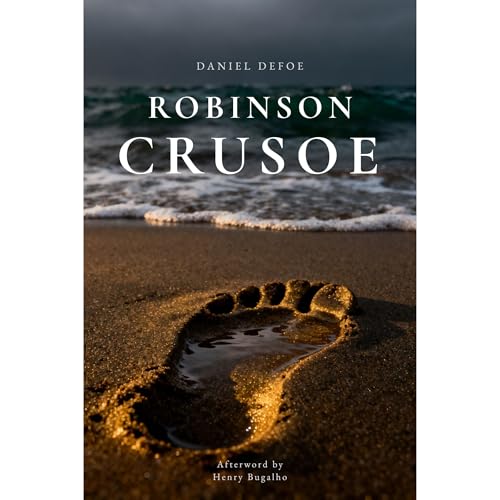
Robinson Crusoe (Annotated)
The Complete Novel by Daniel Defoe — Unabridged, with a Critical Afterword by Henry Bugalho

-
Narrado por:
-
Virtual Voice
-
De:
-
Daniel Defoe

Este título utiliza narración de voz virtual
The first novel in the English language — complete, unabridged, with two critical essays and a biographical afterword.
In 1719, a bankrupt merchant, political spy, and Dissenting pamphleteer named Daniel Defoe published a book that would change the course of Western literature. Robinson Crusoe was not merely an adventure story. It was the invention of a new way of writing about human consciousness — and, as generations of readers and thinkers from Rousseau to Marx to Coetzee have recognized, a founding myth of the modern world.
Crusoe is shipwrecked. Alone on an island for twenty-eight years, he must reconstruct everything — shelter, food, time, meaning, identity itself. What Defoe discovers in this stripping away is both terrifying and generative: the self is not a fixed entity that existed before the island. It is constructed through the acts of naming, documenting, and building that Crusoe performs obsessively throughout his captivity. The journal, the calendar carved into wood, the lists of salvaged goods — these are not pastimes. They are ontological acts, desperate attempts to maintain coherence against the void.
What makes this edition different:
- Complete and unabridged — the full original text, not a simplified retelling or children's adaptation
- Two substantial critical essays by Henry Bugalho:
"The Island Within" explores Robinson Crusoe as a novel about far more than survival — about the construction of identity through solitude, the sacralization of ordinary objects, the unreliability of Crusoe's own narration, the tension between authentic Puritan faith and capitalist rationality, the epistemological violence inflicted on Friday through language and naming, the island as a laboratory of proto-capitalist accumulation, and the haunting impossibility of Crusoe's return to England
"The Birth of a New World" places the novel in its historical moment — the England of 1719, the expansion of mercantile empire, the rise of the reading public — and examines how Robinson Crusoe pioneered the techniques of formal realism that Ian Watt identified as foundational to the English novel, while also exposing the ideological assumptions embedded in that realism
- A biographical essay on Daniel Defoe — failed merchant, political spy, Dissenting outcast, prisoner, pillory survivor, journalist, and the man who, at nearly sixty years of age, invented the modern novel
Robinson Crusoe has been read as a celebration of individual enterprise and as a critique of it. As a spiritual autobiography and as a secular tale of psychological survival. As a defense of colonialism and as an inadvertent exposure of its violence. This edition takes all of these readings seriously and adds what most editions lack: the intellectual framework to understand why this deceptively simple novel remains, three centuries later, a work of inexhaustible significance.
Edited and with essays by Henry Bugalho, philosopher, writer, and translator of Homer, Machiavelli, Descartes, and Plato.