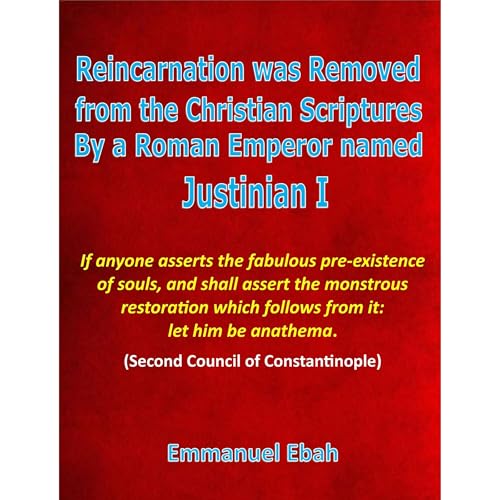
Reincarnation was Removed from the Christian Scriptures by a Roman Emperor Named Justinian I Audiolibro Por Emmanuel Ebah arte de portada

Reincarnation was Removed from the Christian Scriptures by a Roman Emperor Named Justinian I

Muestra de Voz Virtual
Prueba por $0.00
Escucha audiolibros, podcasts y Audible Originals con Audible Plus por un precio mensual bajo.
Escucha en cualquier momento y en cualquier lugar en tus dispositivos con la aplicación gratuita Audible.
Los suscriptores por primera vez de Audible Plus obtienen su primer mes gratis. Cancela la suscripción en cualquier momento.

Reincarnation was Removed from the Christian Scriptures by a Roman Emperor Named Justinian I

De: Emmanuel Ebah
Narrado por: Virtual Voice
Prueba por $0.00

Escucha con la prueba gratis de Plus

Compra ahora por $7.99

Compra ahora por $7.99

Background images

Este título utiliza narración de voz virtual

Voz Virtual es una narración generada por computadora para audiolibros..
This book is designed to deliver a coherent and breathtaking explanation of the events surrounding the abolition of reincarnation from the scriptures of Christianity. In AD 543, the then ruler of the Roman Empire, Emperor Justinian I, blatantly and brutally removed the Teachings of reincarnation from the scriptures of Christian orthodox doctrines. For the first 500 years of Christianity, reincarnation was a vital component of Christian doctrines. In fact, early Christians and church fathers firmly believed in reincarnation. Prominent theologians and church personalities who believed in reincarnation included: Origen, Clement of Alexandria, St Jerome, Synesius, Maximus of Tyre, Johannes Scotus Erigena, just to mention a few. According to Clement of Alexandria, a faithful disciple of the Apostle Paul, Jesus imparted certain secret and sacred Teachings upon Saint Paul, one of which was reincarnation. The Roman Emperor Justinian I, banished the Teachings of reincarnation from Christian doctrines because he was of the view that belief in reincarnation, posed a severe socio-political threat to the Roman Empire. Belief in reincarnation entails the pre-existence of a soul before it enters the physical body during conception. If a soul existed in a spiritual realm prior to taking birth on earth, it means such a soul is somewhat, already aware of its Divine nature and Divine origin. Such a soul could undermine the authority of the emperor, and even belittle the attributed supremacy of the church, as the one and only agency of salvation. Such individuals who are aware of their Divine nature might not even see the need for an emperor. They might even refuse to pay taxes, a scenario that could threaten the political and economic stability of the Roman Empire. The emperor conspired with certain bishops, to foster the belief that only the soul of Jesus came from Heaven and descended onto earth. All other souls are created at the time of conception and had never existed before. Such souls can only enter Heaven through Jesus Christ, alongside the guidance of the church and the wise leadership of the Roman Empire. Thus, Emperor Justinian I conspired to remove the Teachings of reincarnation from Christian doctrines, in order to stop people from conducting serious spiritual inquiry about their Divine origins, and the ultimate purpose of life on earth. In 553 AD, Emperor Justinian I summoned a Council of prominent religious leaders known as the Fifth Ecumenical Council or the Second Council of Constantinople. It was presided over by the incumbent Patriarch of Constantinople, Eutychius. The Council was attended by 165 bishops. Pope Vigilius who himself was a believer in reincarnation, was summoned to the Council but refused to attend. Emperor Justinian I pressurized the attendees to banish reincarnation from the doctrines of the church. The statement of banishment read: If anyone asserts the fabulous pre-existence of souls, and shall assert the monstrous restoration which follows from it: let him be anathema. From then henceforth, reincarnation became foreign to the Christian belief system. This book begins by providing a concise definition of the twin law of karma and reincarnation. The book then supplies a brief historical review of the Ancient Roman Empire. Thereafter, it highlights the means by which Christianity made its way from Israel to the Roman Empire, followed by reflections on how Christianity was established in this powerful Empire. The book then identifies verses in the Bible that support karma and reincarnation, before spotlighting evidence of prominent early Christians, who advocated the doctrine of reincarnation. The book then provides a strongly convincing account of how Emperor Justinian I, abolished belief in reincarnation in Christianity. Finally, the book solidifies the elements discussed, with a succinct and empowering conclusion. Biblias Biblias y Estudio de la Biblia Cristianismo Espiritualidad Reencarnación
Todavía no hay opiniones
