

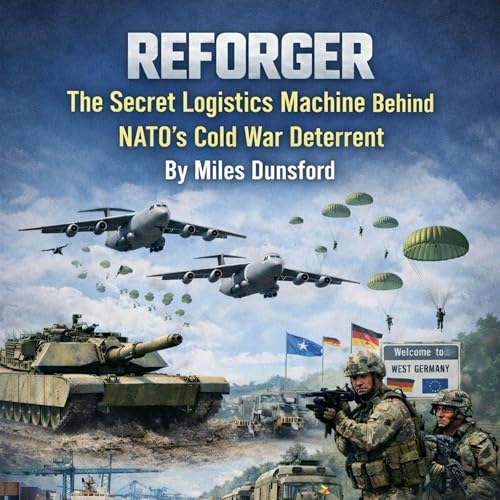
REFORGER
The Secret Logistics Machine Behind NATO’s Cold War Deterrent
No se pudo agregar al carrito
Add to Cart failed.
Error al Agregar a Lista de Deseos.
Error al eliminar de la lista de deseos.
Error al añadir a tu biblioteca
Error al seguir el podcast
Error al dejar de seguir el podcast
Obtén 30 días de Standard gratis

REFORGER
Compra ahora por $15.90
-
Narrado por:
-
Erin B Clark
-
De:
-
Miles Dunsford
The Cold War is often remembered as a contest of missiles, rhetoric, and nuclear brinkmanship. But beneath the headlines, another kind of power quietly held Europe together. It wasn’t glamorous. It didn’t roar across television screens in columns of tanks or dramatic speeches. It lived in schedules, shipping routes, fuel calculations, rail timetables, warehouse inventories, and the disciplined precision of men and women who understood a hard truth: deterrence is only credible if you can move.
That hidden power had a name: REFORGER. Return of Forces to Germany.
On the surface, REFORGER was an exercise. In reality, it was one of NATO’s most important strategic machines—an annual proof that the alliance could reinforce West Germany fast enough to survive the opening shock of a Warsaw Pact assault. NATO feared that if war ever came, it would come quickly: a sudden surge of Soviet-led mass, designed to break through before reinforcements could arrive, and to present the West with an irreversible fait accompli. The Warsaw Pact had proximity on its side. NATO had distance. And in a war measured in hours, distance could be fatal.
REFORGER existed to remove that vulnerability. It was designed to answer the most dangerous question of the era: could the United States actually show up in time?
This book takes you inside the vast, tightly coordinated system that made the answer believable. It explains how REFORGER evolved from concept to annual reality, and why its success mattered as much as any missile deployment. It breaks down the “Return of Forces” plan—rapid airlift of troops, fast reception in Europe, and the race to become combat-ready before the front collapsed. It explores the strategic brilliance of POMCUS, the pre-positioned equipment sites that stored American tanks, artillery, and armoured vehicles on European soil, maintained year-round and waiting for soldiers who would arrive by air.
©2026 Deep Vision Media t/a Zentara UK (P)2026 Deep Vision Media t/a Zentara UKLos oyentes también disfrutaron:

Continuar la serie


El oyente recibió este título gratis
Behind The Curtain
Se ha producido un error. Vuelve a intentarlo dentro de unos minutos.
El oyente recibió este título gratis
The sections on POMCUS and the rapid reinforcement plans were especially interesting. They gave me a new appreciation for how much planning went into something most people would assume was purely military. At times the detail on logistics systems and coordination gets dense, but it’s necessary to understand the scale of what was being attempted. Overall, it’s a well-structured and informative look at a hidden side of NATO operations.
Logistics as Strategy, Not Background Detail
Se ha producido un error. Vuelve a intentarlo dentro de unos minutos.
El oyente recibió este título gratis
The structure is particularly strong. Each section builds logically from the strategic problem to the practical solution, and the author avoids unnecessary jargon. I also liked how the book repeatedly connects large-scale military planning back to real-world urgency—especially the fear that Europe could fall before reinforcements arrived.
It’s the kind of history that makes you appreciate the unseen systems behind global stability. Even if you’re not a military enthusiast, the clarity of the writing makes it easy to follow and genuinely interesting.
Surprisingly Clear and Well Structured
Se ha producido un error. Vuelve a intentarlo dentro de unos minutos.
El oyente recibió este título gratis
Hidden Cold Power
Se ha producido un error. Vuelve a intentarlo dentro de unos minutos.
El oyente recibió este título gratis
I especially appreciated how the book builds tension around a simple question: could reinforcements actually arrive in time if war broke out in Europe? That uncertainty gives weight to every detail about airlift planning, rail movement, and equipment staging. The explanation of how entire systems had to function under extreme time pressure made me rethink what “readiness” actually means.
By the end, what stayed with me wasn’t just the technical detail, but the broader idea that global stability during the Cold War relied on invisible systems working perfectly behind the scenes. It’s a reminder that some of the most important parts of history are the ones that never made the headlines.
A Quietly Powerful Story About Preparation and Pre
Se ha producido un error. Vuelve a intentarlo dentro de unos minutos.