

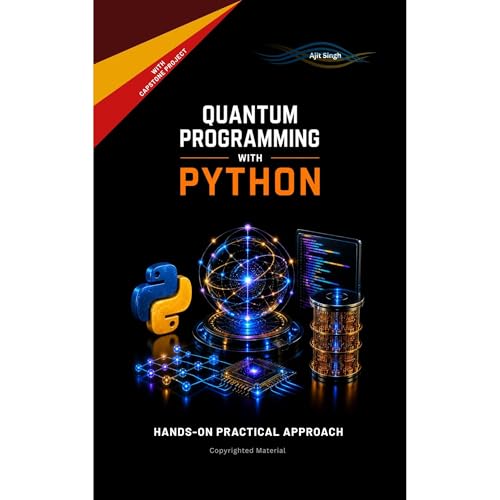
Quantum Programming with Python
No se pudo agregar al carrito
Solo puedes tener X títulos en el carrito para realizar el pago.
Add to Cart failed.
Por favor prueba de nuevo más tarde
Error al Agregar a Lista de Deseos.
Por favor prueba de nuevo más tarde
Error al eliminar de la lista de deseos.
Por favor prueba de nuevo más tarde
Error al añadir a tu biblioteca
Por favor intenta de nuevo
Error al seguir el podcast
Intenta nuevamente
Error al dejar de seguir el podcast
Intenta nuevamente
Obtén 30 días de Standard gratis
$8.99 al mes después de que termine la prueba. Cancela en cualquier momento

Quantum Programming with Python
Narrado por:
Virtual Voice
Compra ahora por $8.90
-
Narrado por:
-
Virtual Voice
-
De:
-
Ajit Singh

Este título utiliza narración de voz virtual
Voz Virtual es una narración generada por computadora para audiolibros..
Philosophy
The core philosophy of this book is "Implementation First." While a conceptual understanding of quantum phenomena like superposition and entanglement is necessary, this book posits that the most effective way for a programmer to learn these concepts is by actively programming them. Every theoretical point is immediately followed by Python code that demonstrates the principle in action. The objective is not to create theoretical physicists but to empower competent quantum software developers. I treated the quantum computer and its accompanying SDKs as a new kind of processing unit with a unique instruction set, and my primary goal is to teach you how to write effective code for this new hardware. The emphasis is consistently on the "how"—how to design a quantum circuit, how to implement an algorithm, and how to develop a complete quantum-powered application.
Key Features
1. Python-Based: Utilizes Python, the most popular language for scientific computing, ensuring the skills learned are immediately applicable.
2. Industry-Standard Tools: Focuses on leading quantum SDKs like Qiskit and Cirq, aligning with the tools used in corporate and research environments.
3. Beginner to Advanced: The content is structured to be accessible to beginners with no quantum background while also providing sufficient depth and advanced topics (like VQE, QAOA, and QML) for postgraduate students and professionals.
4. Algorithm Simplicity: Quantum algorithms are presented in the clearest possible way, with an emphasis on the implementation logic rather than dense mathematical derivations.
5. Complete Project Lifecycle: The book covers not just the implementation of algorithms but also discusses aspects of design, architecture, deployment on simulators and real hardware, and analysis of results.
6. NISQ-Era Relevant: A dedicated focus on algorithms and applications (like optimization and quantum chemistry) that are relevant for today's Noisy Intermediate-Scale Quantum (NISQ) devices.
Note: A prerequisite of basic programming proficiency in Python is assumed. Familiarity with high-school level linear algebra (vectors and matrices) will be beneficial but is not strictly required, as core concepts are introduced intuitively.
Key Takeaways
Upon completing this book, the reader will be able to:
1. Set up a Python-based quantum development environment.
2. Design, build, and simulate quantum circuits to manipulate qubits.
3. Implement fundamental quantum algorithms like Grover's Search and Shor's Algorithm from scratch.
4. Apply quantum computing to practical problem domains like optimization, finance, and machine learning using modern hybrid algorithms (VQE, QAOA).
5. Understand the architecture and functioning of NISQ-era quantum systems and the challenges of quantum noise.
6. Develop, code, and test a complete, end-to-end quantum application by completing the capstone project.
Disclaimer: Earnest request from the Author.
Kindly go through the table of contents and refer kindle edition for a glance on the related contents.
Thank you for your kind consideration!
adbl_web_anon_alc_button_suppression_t1
Todavía no hay opiniones