

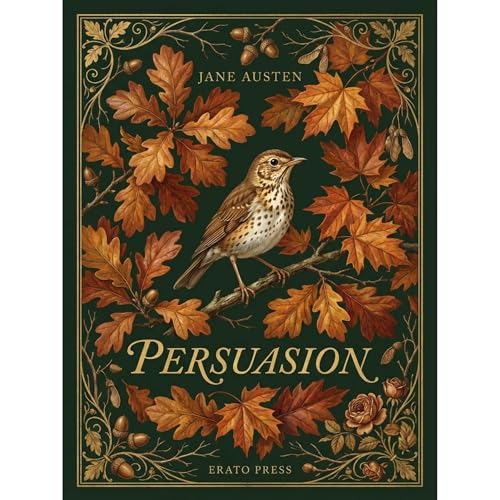
Persuasion (Annotated)
Critical Edition with Afterword, Historical Context, and Biography | Jane Austen | Erato Press
No se pudo agregar al carrito
Add to Cart failed.
Error al Agregar a Lista de Deseos.
Error al eliminar de la lista de deseos.
Error al añadir a tu biblioteca
Error al seguir el podcast
Error al dejar de seguir el podcast
Prueba gratis de 30 días de Audible Standard

Persuasion (Annotated)
Compra ahora por $5.99
-
Narrado por:
-
Virtual Voice
-
De:
-
Jane Austen

Este título utiliza narración de voz virtual
Jane Austen's last novel — and her most radical. The one in which the heroine already knows everything the other heroines spend the book learning.
Jane Austen completed Persuasion in 1816, less than a year before her death. It was published posthumously in 1818, alongside Northanger Abbey, and has been overshadowed by the louder novels ever since. It is quieter than Pride and Prejudice, less comic than Emma, less dramatic than Sense and Sensibility. It is also, by many measures, the most perfectly made thing Austen wrote.
Anne Elliot is twenty-seven years old when the novel begins — old, by the standards of Austen's world, for a woman who is not yet married. Eight years earlier, she loved Frederick Wentworth and was persuaded, by her friend Lady Russell, to give him up. He was without fortune or connections; the match was unsuitable; she was nineteen and she listened to reason. Now Wentworth has returned — successful, admired, and, it seems, indifferent.
What makes Persuasion unlike every other Austen novel is that Anne does not need to learn anything. Elizabeth Bennet must overcome her prejudice. Emma Woodhouse must overcome her self-deception. Catherine Morland must grow up. Anne Elliot already knows what she lost, what it cost her, and why. The novel is not about discovery — it is about endurance. About what it means to have been right all along and still to have been alone.
The letter Wentworth writes in Chapter Twenty-Three — "I am half agony, half hope" — is the most celebrated moment in all of Austen. It earned that place.
Anne Elliot — who has been overlooked by her own family for so long that she has learned to overlook herself, and who has never, in eight years, stopped being right
Captain Wentworth — who left angry and returned successful and finds that neither condition has settled what he thought it would
Lady Russell — who gave Anne the best advice she could and was wrong in a way that cannot be undone
Sir Walter Elliot — Anne's father, who has never in his life noticed anything that was not a reflection of his own consequence
✦ The complete unabridged text of Jane Austen's final novel
This edition also includes: ✦ Afterword: The Aesthetics of Loss — a critical essay by Henry Bugalho on how Persuasion breaks with every pattern in the Austen canon: the novel of second chances rather than first discoveries ✦ The World of Jane Austen: England in the Age of Revolution — historical context in eight sections, including the English class system, women's lives, Empire and slavery, and the Regency ✦ Jane Austen: A Life in Letters and Silence — biography in six parts
For readers who enjoy: ✦ Jane Austen's complete novels including Pride and Prejudice, Emma, and Sense and Sensibility ✦ Women's literary fiction and the great novels of feeling and constraint ✦ Fiction about women navigating loss, time, and the possibility of second chances ✦ Works by Charlotte Brontë, Elizabeth Gaskell, and the tradition of British women's fiction
You pierce my soul. I am half agony, half hope. Tell me not that I am too late, that such precious feelings are gone for ever. — Jane Austen, Persuasion