

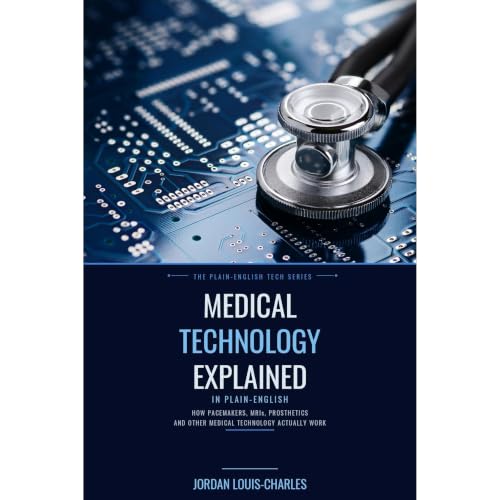
Medical Technology Explained
How Pacemakers, MRIs, Prosthetics and Other Medical Technology Actually Work
No se pudo agregar al carrito
Solo puedes tener X títulos en el carrito para realizar el pago.
Add to Cart failed.
Por favor prueba de nuevo más tarde
Error al Agregar a Lista de Deseos.
Por favor prueba de nuevo más tarde
Error al eliminar de la lista de deseos.
Por favor prueba de nuevo más tarde
Error al añadir a tu biblioteca
Por favor intenta de nuevo
Error al seguir el podcast
Intenta nuevamente
Error al dejar de seguir el podcast
Intenta nuevamente
Obtén 30 días de Standard gratis
$8.99 al mes después de que termine la prueba. Cancela en cualquier momento

Medical Technology Explained
Narrado por:
Virtual Voice
Compra ahora por $11.99
-
Narrado por:
-
Virtual Voice

Este título utiliza narración de voz virtual
Voz Virtual es una narración generada por computadora para audiolibros..
Inside this book, readers will learn how to:
- Understand cardiac devices by following how pacemakers and defibrillators sense the heart's electrical activity and deliver precisely timed pulses or a life-saving shock.
- Decode cochlear implants and hearing aids to see how sound is captured, processed, and converted into nerve signals the brain can learn to hear again.
- Grasp bionic and artificial limbs including how myoelectric control reads muscle signals through the skin to move a prosthetic hand or leg.
- Follow insulin pumps and continuous glucose monitors as they measure blood sugar and adjust delivery in closed-loop systems that ease daily diabetes management.
- See inside X-rays and CT scans by learning how radiation passes through tissue to build flat images and full three-dimensional views of the body.
- Demystify MRI and ultrasound so you understand how magnetic fields, radio waves, and sound waves create detailed pictures without ionizing radiation.
- Explore robotic surgery and how a surgeon's hand motions are scaled, steadied, and translated into precise movements inside the patient.
- Interpret wearable health sensors that track heart rate, blood oxygen or SpO2, and sleep, and learn what those readings can and cannot tell you.
- Separate fact from myth with plain-English safety context and biomedical engineering explained for patients, caregivers, and curious readers alike.
The result is a shift from anxiety to confidence. Instead of nodding along to instructions you do not fully understand, you can picture what a device is doing inside the body, ask sharper questions, and make better sense of the answers. Understanding the machine changes the whole experience, whether it belongs to you or to someone you love. This is not medical advice and it does not diagnose or treat anything; it explains the mechanisms behind modern care so you can be an informed, active participant in it.
adbl_web_anon_alc_button_suppression_t1
Todavía no hay opiniones