

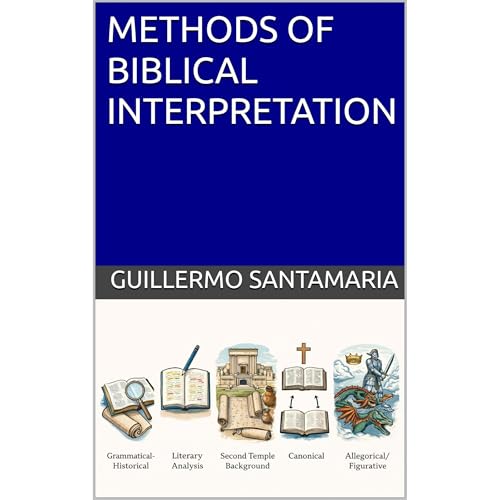
METHODS OF BIBLICAL INTERPRETATION
No se pudo agregar al carrito
Add to Cart failed.
Error al Agregar a Lista de Deseos.
Error al eliminar de la lista de deseos.
Error al añadir a tu biblioteca
Error al seguir el podcast
Error al dejar de seguir el podcast
 Exclusivo para miembros Prime: ¿Nuevo en Audible? Obtén 2 audiolibros gratis con tu prueba.
METHODS OF BIBLICAL INTERPRETATION
Compra ahora por $3.99
-
Narrado por:
-
Virtual Voice

Este título utiliza narración de voz virtual
Your book argues—pretty coherently—that the “methods” of interpretation are real tools, but the decisive issue is spiritual epistemology: who makes the Word living to the hearer? The thesis is that grammatical-historical constraints (grammar, genre, historical setting) are valuable as guards against interpretive acrobatics, yet they remain insufficient to produce saving understanding. The foreword frames this with the central contrast: method can dissect; only the Spirit can vivify—illumination being defined not as new revelation, but as the Spirit opening the reader to perceive, feel, and submit to what is already written.
Historically, the book traces the method’s ancient instinct to the Antiochene preference for the literal-historical sense, notes the medieval “four senses” without losing the literal layer, then shows the Reformation’s linguistic recovery (Hebrew/Greek) as an accelerant. It then distinguishes practice from terminology: the label “grammatical-historical” is treated as a 19th-century coinage (Keil), systematizing what Ernesti taught and what Moses Stuart helped transmit into American theological education. The modern era is framed as a contest of badges—“grammatical-historical” as an evangelical marker over against “historical-critical”—while acknowledging that contemporary interpreters often supplement GH with literary, Second Temple, and canonical approaches.
The Old School Baptist section (explicitly Absoluter-leaning) positions them as pragmatic users of “literal” tools who nevertheless insist on a threefold aim—literal, spiritual, practical—and who distrust any method that becomes a substitute authority (“a new pope”). Their boundary conditions are: Scripture as the only rule, and the Spirit as the teacher who makes the text effectual. The final sections then map out alternatives that “reject” GH (Alexandrian spiritualizing, medieval quadriga, reader-centered theories, and modern theological critiques of GH as sufficient), and it closes by observing that the Bible itself models a layered interpretive practice: plain-sense reading, Scripture interpreting Scripture, typology, promise–fulfillment, mystery/fulfillment in Christ, and rare signposted allegory—plus the key conclusion that prophecy is “literal” according to genre (often concrete, sometimes poetic-symbolic, sometimes conditional, often typological, and apocalyptic least literalistic).