

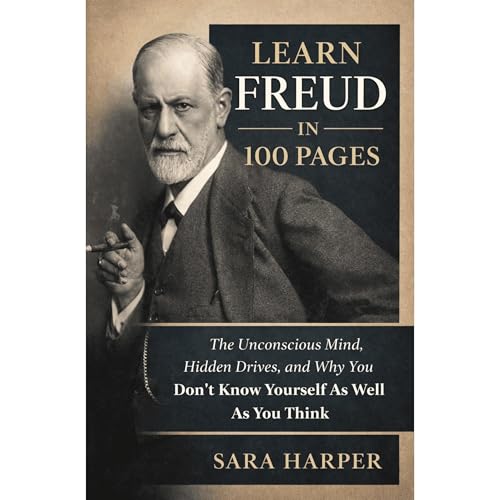
Learn Freud in 100 Pages
The Unconscious Mind, Hidden Drives, and Why You Don't Know Yourself As Well As You Think
No se pudo agregar al carrito
Add to Cart failed.
Error al Agregar a Lista de Deseos.
Error al eliminar de la lista de deseos.
Error al añadir a tu biblioteca
Error al seguir el podcast
Error al dejar de seguir el podcast
Prueba gratis de 30 días de Audible Standard

Learn Freud in 100 Pages
Compra ahora por $4.99
-
Narrado por:
-
Virtual Voice
-
De:
-
Sara Harper

Este título utiliza narración de voz virtual
Finally Understand the Father of Psychoanalysis—What He Got Right, What He Got Wrong, and Why He Still Matters
Ego. Defense mechanisms. Freudian slips. Repression. Denial. The unconscious mind.
You use these terms constantly. But do you actually understand where they came from and what they mean?
Sigmund Freud fundamentally changed how Western culture thinks about human nature. Before him, consciousness was the mind—if you weren't aware of something, it wasn't part of your psychology. He said no, most of what drives you operates below awareness, and you don't know yourself as well as you think you do.
Was he always right? Absolutely not. Modern neuroscience and psychology have challenged many of his specific claims. His theories about women were often sexist. His therapeutic methods were sometimes problematic. His scientific evidence was frequently weak.
But here's why you need to understand him anyway:
He asked the questions that still matter: Are we really as rational as we believe? Do we actually know why we do what we do? How much of our behavior is driven by forces we don't consciously recognize? How do childhood experiences shape who we become as adults?
He invented the talking cure—the foundation of all modern psychotherapy, whatever its theoretical orientation.
He gave us the vocabulary we still use to discuss psychological experience.
He made it culturally acceptable to take your inner life seriously, to examine your own psychology, to assume emotional problems deserve attention rather than just judgment.
In This Book, You'll Learn:
- The unconscious mind and how it actually operates—not mystical, but deeply practical
- The Id, Ego, and Superego: the three-part structure of personality and how they create internal conflict
- Defense mechanisms: repression, denial, projection, rationalization, reaction formation, and sublimation
- The psychosexual stages and what Freud believed they determine about adult personality
- How to interpret dreams using Freud's methods (manifest vs. latent content, dreamwork mechanisms)
- The "talking cure" and how psychoanalysis revolutionized mental health treatment
- Freud's dark final philosophy: Eros vs. Thanatos, civilization and its discontents
- Why his legacy endures even when his specific theories don't hold up
What Makes This Book Different:
No academic jargon. This is written the way a brilliant professor would explain Freud if you had their undivided attention—clear, engaging, intelligent without being intimidating.
Honest about what's wrong. This book doesn't pretend Freud was always right. It acknowledges criticisms while explaining why he still matters.
Focused on what's essential. Every concept that changed culture. Nothing that doesn't matter. 100 pages of concentrated insight, not 400 pages of filler.
Actually readable. Structured like a great lecture series, with clear explanations, memorable examples, and the occasional dose of dark humor that matches Freud's own sensibility.
Whether you're a student encountering Freud for the first time, a curious reader who wants to understand cultural references you keep encountering, or someone interested in psychology and the history of ideas, this book gives you everything you need to understand why this controversial, frequently-wrong thinker remains essential reading more than a century after he began developing his theories.