

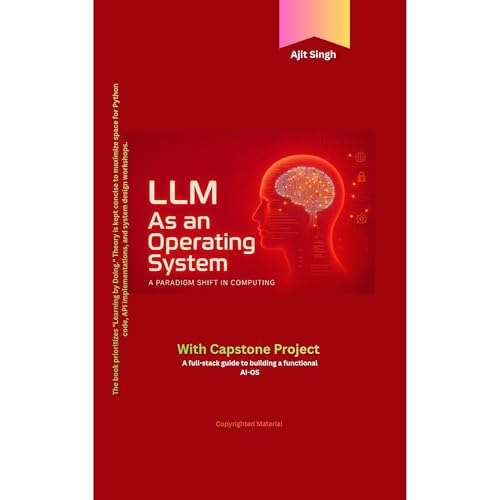
LLM : As an Operating System
No se pudo agregar al carrito
Solo puedes tener X títulos en el carrito para realizar el pago.
Add to Cart failed.
Por favor prueba de nuevo más tarde
Error al Agregar a Lista de Deseos.
Por favor prueba de nuevo más tarde
Error al eliminar de la lista de deseos.
Por favor prueba de nuevo más tarde
Error al añadir a tu biblioteca
Por favor intenta de nuevo
Error al seguir el podcast
Intenta nuevamente
Error al dejar de seguir el podcast
Intenta nuevamente
Prueba gratis de 30 días de Audible Standard
Selecciona 1 audiolibro al mes de nuestra colección completa de más de 1 millón de títulos.
Es tuyo mientras seas miembro.
Obtén acceso ilimitado a los podcasts con mayor demanda.
Plan Standard se renueva automáticamente por $8.99 al mes después de 30 días. Cancela en cualquier momento.

LLM : As an Operating System
Narrado por:
Virtual Voice
Compra ahora por $6.30
-
Narrado por:
-
Virtual Voice
-
De:
-
Ajit Singh

Este título utiliza narración de voz virtual
Voz Virtual es una narración generada por computadora para audiolibros..
"LLM: As an Operating System" is conceptualized around a singular philosophy: Democratization through Simplification. Complex AI architectures should not remain in the ivory towers of research labs. This book treats the Large Language Model not as a mystical "black box," but as a deterministic, manageable, and architectable component of a system—much like an Operating System kernel.
Pedagogy:
1. Concept Visualization: Every chapter begins with a high-level architecture equating AI concepts to standard OS concepts (e.g., Context Window = RAM).
2. Scaffolding: We will move from known (Traditional Coding) to unknown (Probabilistic AI), ensuring students build upon their existing CS knowledge.
3. Experiential Learning: The book prioritizes "Learning by Doing." Theory is kept concise to maximize space for Python code, API implementations, and system design workshops.
Key Features:
1. Analogy-Driven Learning: The book uses the "OS Metaphor" consistently. If you understand how an OS manages threads, you will understand how an LLM manages agents.
2. Industry-Ready Syllabus: The content covers the latest frameworks (LangChain, AutoGPT, Vector DBs) required by top tech recruiters globally.
3. Code-First Approach: Over 40% of the book is code. Written in Python, the examples are modular, reusable, and hosted on GitHub (referenced in the book).
4. Capstone Project: A full-stack guide to building a functional AI-OS, ensuring the student walks away with a portfolio-ready project.
5. Global Compatibility: While rooted in AICTE norms, the syllabus covers the ACM and IEEE guidelines for Undergraduate AI education, making it suitable for US, UK, and European universities.
Target Audience:
1. B.Tech/B.E. Students (CS/IT/AI&DS): As a core textbook for Electives in Generative AI or Advanced Operating Systems.
2. M.Tech/Research Scholars: For understanding the system architecture of Agents.
3. Faculty Members: As a teaching manual to introduce Modern AI without discarding foundational CS theory.
4. Industry Professionals: For developers transitioning from Web2 to Web3/AI development.
Outcomes:
By the end of this book, a reader will not just know what ChatGPT is; they will know how to build a system that uses such models to read files, execute code, browse the internet, and solve complex problems autonomously.
Todavía no hay opiniones