

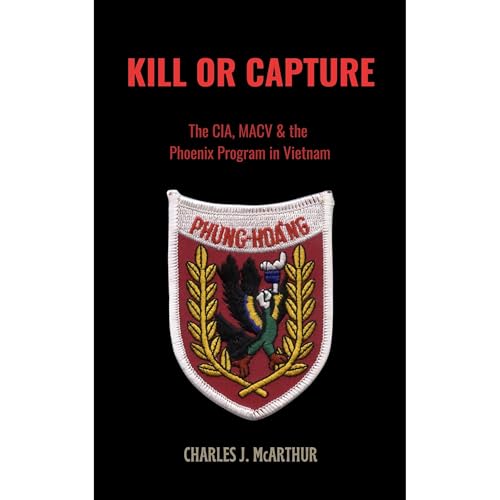
Kill or Capture
The CIA, MACV and the Phoenix Program in Vietnam
No se pudo agregar al carrito
Solo puedes tener X títulos en el carrito para realizar el pago.
Add to Cart failed.
Por favor prueba de nuevo más tarde
Error al Agregar a Lista de Deseos.
Por favor prueba de nuevo más tarde
Error al eliminar de la lista de deseos.
Por favor prueba de nuevo más tarde
Error al añadir a tu biblioteca
Por favor intenta de nuevo
Error al seguir el podcast
Intenta nuevamente
Error al dejar de seguir el podcast
Intenta nuevamente
Obtén 30 días de Standard gratis
$8.99 al mes después de que termine la prueba. Cancela en cualquier momento

Kill or Capture
Narrado por:
Virtual Voice
Compra ahora por $4.99
-
Narrado por:
-
Virtual Voice

Este título utiliza narración de voz virtual
Voz Virtual es una narración generada por computadora para audiolibros..
"The knock usually came after midnight, when villages were at their quietest and the boundary between public life and private fear was thinnest.
In a settlement outside Da Nang in 1969, a schoolteacher named Tran Van Loc was taken from his home by men who did not wear standard uniforms. Some were South Vietnamese officials. One was American. They carried a list, and his name appeared on it. Whether that name had been placed there on the basis of corroborated intelligence or rumor carried through a chain of informants is no longer possible to determine with certainty. In Vietnam, certainty was often the first casualty of suspicion."
This is the story of the Phoenix Program.
The Program Washington Couldn't Explain
Launched in 1967 under Military Assistance Command Vietnam and supported by the CIA, the Phoenix Program, known to the Vietnamese as Phung Hoang, was designed to do what conventional military forces could not: dismantle the Viet Cong's shadow government from within. The Viet Cong Infrastructure was not an army in the field. It was a clandestine political apparatus — tax collectors, recruiters, propagandists, and organizers — embedded invisibly inside villages across South Vietnam. Phoenix was built to find them, neutralize them, and destroy the insurgency's administrative spine.
What followed became one of the most controversial covert operations in American military history.
Kill Lists. Night Raids. Contested Truth.
Critics called it a CIA assassination program — targeted killings dressed in bureaucratic language. Defenders insisted it was a coordinated intelligence effort operating within Vietnamese law, with capture always preferred over killing. Congressional hearings turned the word "neutralization" into a moral indictment. Future CIA Director William Colby testified it was lawful, structured, and essential to the war effort.
The declassified record tells a more complicated story.
Built from the Classified Archives
Drawing on declassified CIA documents, MACV directives, congressional testimony, and military intelligence archives, Kill or Capture examines how the program actually functioned — from the coordination centers that turned informant intelligence into target folders, to the Provincial Interrogation Centers where Phoenix's claim to legitimacy was most severely tested. It traces operations across the contested provinces of Military Region 1, follows the shock of the 1968 Tet Offensive, and confronts the quota pressures, flawed intelligence, and provincial realities that could bend a system designed for precision into something far harder to defend.
Phoenix was neither the clean assassination machine its critics claimed nor the restrained legal mechanism its defenders described. It was a modern state's attempt to fight a clandestine political enemy using files, committees, night raids, and coercion — and the story of how easily that attempt could be corrupted by fear, incentives, and the moral fog of a war fought not on open battlefields, but in villages, in darkness, and on lists.
For readers of Vietnam War history, military intelligence, CIA espionage, covert operations, and US veterans history — essential reading from a #1 Amazon bestselling author.
Las personas que vieron esto también vieron:


Todavía no hay opiniones