

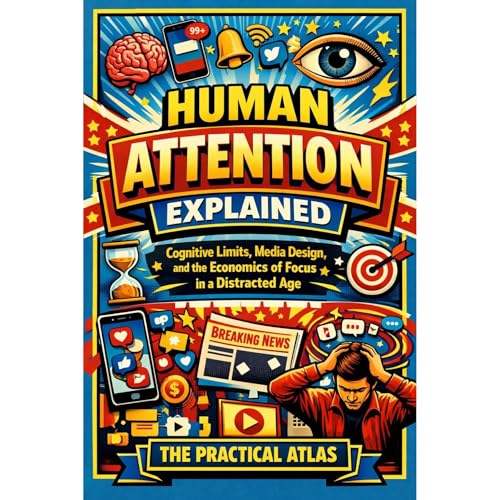
Human Attention Explained
Cognitive Limits, Media Design, and the Economics of Focus in a Distracted Age
No se pudo agregar al carrito
Add to Cart failed.
Error al Agregar a Lista de Deseos.
Error al eliminar de la lista de deseos.
Error al añadir a tu biblioteca
Error al seguir el podcast
Error al dejar de seguir el podcast
Prueba gratis de 30 días de Audible Standard

Human Attention Explained
Compra ahora por $3.99
-
Narrado por:
-
Virtual Voice

Este título utiliza narración de voz virtual
Human Attention Explained: Cognitive Limits, Media Design, and the Economics of Focus in a Distracted Age is a deep, accessible exploration of why focus has become one of the most valuable and contested resources of modern life. In a world of endless notifications, infinite feeds, and constant information overload, this book explains what is happening inside the human mind, why concentration feels harder than ever, and how attention has quietly become the currency driving digital media, advertising, and online platforms.
Drawing on cognitive science, psychology, evolutionary theory, and economics, this book shows that distraction is not a personal failure. Human attention evolved for environments of scarcity, not abundance. Our brains are biologically limited in how much information they can process, how long focus can be sustained, and how often attention can be switched without cost. Modern systems exploit these limits through persuasive design, behavioral engineering, and engagement-driven media, creating chronic cognitive overload, fatigue, and anxiety.
Rather than offering simplistic productivity hacks, Human Attention Explained provides a clear framework for understanding the attention economy itself. It examines how social media commodifies awareness, how news and advertising industrialize distraction, and how design choices quietly shape behavior at scale. Readers gain insight into why multitasking fails, why focus feels fragile, and why constant engagement often leads to mental exhaustion rather than fulfillment.
The book also offers practical, evidence-based ways to reclaim attention without rejecting technology altogether. By aligning habits, environments, and tools with cognitive reality, readers can rebuild focus in a sustainable way. The final chapters explore ethical media design and the future of human attention, asking how technology might better serve human well-being rather than undermine it. Clear, thoughtful, and grounded in research, this book is ideal for readers interested in psychology, media studies, digital well-being, productivity, and understanding how attention shapes modern life.
FROM THE HALF HOUR HELP SERIES OF BOOKS
The Half Hour Help Series is a collection of concise, practical guides designed to teach the basics of a subject or provide quick solutions to everyday problems. Each book is crafted to be read in about 30 minutes, making it ideal for busy readers who want to learn something new or solve a specific issue without wading through lengthy manuals or complex jargon.
Whether you're looking to understand a new concept, develop a skill, or tackle a challenge, these guides break things down into simple, actionable steps.
Focused on clarity and efficiency, the Half Hour Help Series covers a wide range of topics—from personal development and productivity to science and technology, wellness, culture, and beyond.
Every title is built around the idea that a little help can go a long way, and with just half an hour, readers can gain valuable insights and confidence to move forward.
It's smart support when you need it, without the fluff.