

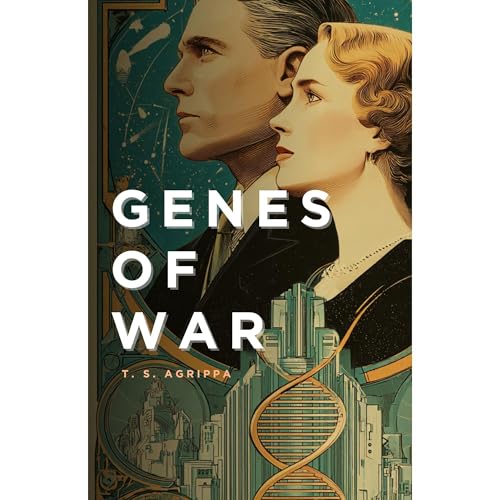
Genes Of War
The Hidden Genetic Competition Reshaping European Civilization
No se pudo agregar al carrito
Add to Cart failed.
Error al Agregar a Lista de Deseos.
Error al eliminar de la lista de deseos.
Error al añadir a tu biblioteca
Error al seguir el podcast
Error al dejar de seguir el podcast
Prueba gratis de 30 días de Audible Standard

Genes Of War
Compra ahora por $7.99
-
Narrado por:
-
Virtual Voice
-
De:
-
T. S. Agrippa

Este título utiliza narración de voz virtual
"Life, that mysterious four-billion-year-old algorithm, ever discovering new ways to escape entropy through replication."
In Genes of War: The Hidden Genetic Competition Reshaping Global Civilization, T. S. Agrippa launches a monumental and unsparing exploration of the biological forces that have shaped humanity. Challenging comforting fictions and intellectual orthodoxies, Agrippa argues that our grandest endeavors—from the rise and fall of empires to our most intimate choices in love—are, at their root, expressions of an ancient, relentless, and unconscious genetic game.
At the heart of this narrative lies the Y chromosome, a singular genetic element passed almost entirely unchanged from father to son. The Y chromosome serves as an "unredacted record of our direct paternal ancestry," an "unblinking rapporteur of lineage" that allows scientists to meticulously reconstruct human migrations and conquests over tens of thousands of years. Agrippa reveals how rare mutations act as a "molecular clock," dating humanity's common paternal ancestor ("Y-Chromosome Adam") and mapping the dramatic population replacements that have defined our past.
The book then discusses the concept of the "genetic commons"—the vast, promiscuous pool of autosomal DNA inherited from all ancestors—which has been relentlessly edited by natural selection. Europe, he shows, is a "genetic palimpsest," bearing the layered inscriptions of Paleolithic hunters, Neolithic farmers, and Bronze Age steppe pastoralists whose violent admixtures forged a population uniquely adapted to its environment. Traits like lactase persistence, disease resistance, and a specific "portfolio of genetic traits" for cognitive ability are revealed as the evolutionary dividends of this brutal history.
Agrippa confronts the deeply uncomfortable truths of evolutionary psychology, arguing that males and females are not built to the same psychological blueprint. Testosterone, risk-taking, and the "high-variance reproductive strategy" of men are presented as primal directives honed by millennia of intense male-male competition for reproductive success, where "the median human male in history died without issue." This fundamental asymmetry, Agrippa contends, explains everything from historical patterns of male-dominated migration to the stark reality of modern refugee crises, viewed through the lens of "genes on the move, opportunistically seeking purchase in a new and fertile environment."
Agrippa unflinchingly applies the gene-centric view to culture and politics, positing that our institutions, laws, and even moral intuitions are "extended phenotypes of human genes," sophisticated strategies for propagating genetic information. He traces the ancient history of eugenics, from Plato's Republic and the Indian caste system to the Habsburg dynasty, exposing the constant temptation of power to "herd" human reproduction.
The "replicator wars" culminate in a stark examination of contemporary global challenges, where differential fertility rates between populations are depicted as a "demographic battlefield" with profound implications for genetic makeup and "cognitive capital." T.S. Agrippa argues that a "wilful blindness" to these biological realities is leading to a "civilizational senescence," forcing societies to confront difficult choices about their genetic and cultural continuity.
Genes of War is a work of unflinching intellectual honesty, drawing on the latest breakthroughs in ancient DNA, population genetics, and evolutionary psychology. It is a challenging, necessary book for anyone brave enough to confront the raw, biological reality underlying human history and the unfolding dramas of our present. It will fundamentally alter your understanding of who we are, where we came from, and where we are inexorably heading.