

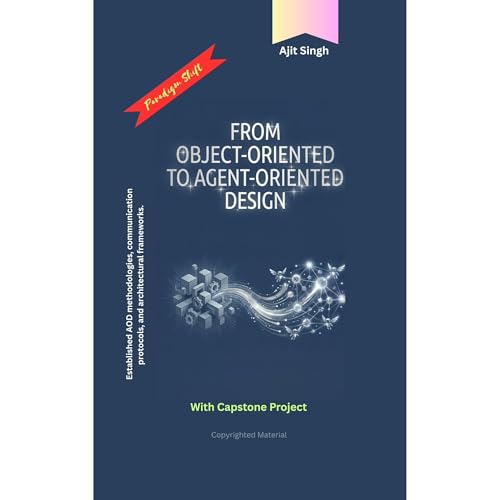
From Object-Oriented to Agent-Oriented Design
No se pudo agregar al carrito
Solo puedes tener X títulos en el carrito para realizar el pago.
Add to Cart failed.
Por favor prueba de nuevo más tarde
Error al Agregar a Lista de Deseos.
Por favor prueba de nuevo más tarde
Error al eliminar de la lista de deseos.
Por favor prueba de nuevo más tarde
Error al añadir a tu biblioteca
Por favor intenta de nuevo
Error al seguir el podcast
Intenta nuevamente
Error al dejar de seguir el podcast
Intenta nuevamente
Prueba gratis de 30 días de Audible Standard
Selecciona 1 audiolibro al mes de nuestra colección completa de más de 1 millón de títulos.
Es tuyo mientras seas miembro.
Obtén acceso ilimitado a los podcasts con mayor demanda.
Plan Standard se renueva automáticamente por $8.99 al mes después de 30 días. Cancela en cualquier momento.

From Object-Oriented to Agent-Oriented Design
Narrado por:
Virtual Voice
Compra ahora por $6.30
-
Narrado por:
-
Virtual Voice
-
De:
-
Ajit Singh

Este título utiliza narración de voz virtual
Voz Virtual es una narración generada por computadora para audiolibros..
Philosophy:
The core philosophy of this book is that AOD is not merely an extension of OOD but a fundamental shift in perspective. It advocates for viewing complex systems not as a collection of passive data structures (objects) but as a society of autonomous, proactive, and collaborative entities (agents). This approach is uniquely suited to tackling the challenges of modern software applications, such as decentralized finance, autonomous vehicle coordination, smart grids, and large-scale AI systems. I believe that by internalizing this agent-centric worldview, developers can design systems that are more robust, scalable, and intelligent.
Key Features:
1. Global Syllabus Compatibility: The foundational and advanced topics covered are universally relevant and map easily to B.Tech/M.Tech computer science syllabi across the world.
2. Beginner to Advanced: The book is structured to cater to both beginners with a basic knowledge of programming and OOD, as well as advanced learners or professionals looking to specialize in Multi-Agent Systems (MAS).
3. Complete Capstone Project: Chapter 10 provides a complete, step-by-step guide to building a live AOD project, including full source code and detailed explanations.
4. Comprehensive Coverage: Each chapter thoroughly explores the design, models, architecture, frameworks, implementation, deployment, and future scope of the topics discussed.
5. Clarity and Simplicity: The language used is deliberately simple and direct, breaking down complex topics into easily digestible parts.
To Whom This Book is Addressed:
This book is primarily intended for:
1. Undergraduate (B.Tech/B.E.) Students: Computer Science, Information Technology, and other related engineering disciplines who are studying software engineering, object-oriented programming, or artificial intelligence.
2. Postgraduate (M.Tech/M.E./M.S.) Students: Those specializing in AI, Distributed Systems, Software Engineering, or Robotics who require a deep, practical understanding of AOD and MAS.
3. Software Developers and Architects: Professionals working in the industry who wish to upgrade their skills and learn how to design and build intelligent, autonomous, and distributed systems.
4. Researchers and Academicians: Individuals exploring the frontiers of AI and software engineering who need a consolidated and practical reference on AOD.
5. Hobbyists and AI Enthusiasts: Anyone with a programming background who is curious about building intelligent agent-based applications.
Disclaimer: Earnest request from the Author.
Kindly go through the table of contents and refer kindle edition for a glance on the related contents.
Thank you for your kind consideration!
Todavía no hay opiniones