

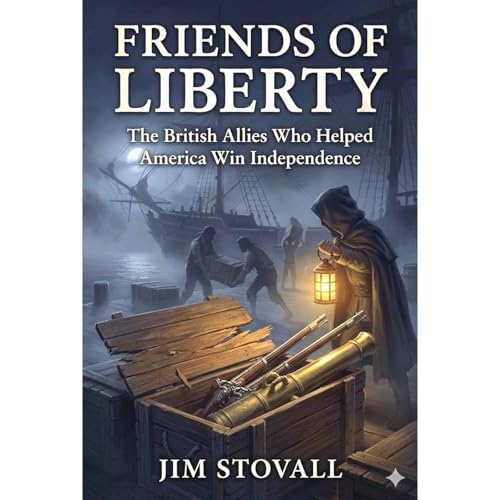
Friends of Liberty
The British Allies Who Helped America Win Independence
No se pudo agregar al carrito
Add to Cart failed.
Error al Agregar a Lista de Deseos.
Error al eliminar de la lista de deseos.
Error al añadir a tu biblioteca
Error al seguir el podcast
Error al dejar de seguir el podcast
Obtén 30 días de Standard gratis

Friends of Liberty
Compra ahora por $11.99
-
Narrado por:
-
Virtual Voice
-
De:
-
JIM STOVALL

Este título utiliza narración de voz virtual
In the spring 1775, John Wilkes—Lord Mayor of London—came close to treason.
He secretly helped supply French arms to American rebels, an act punishable by death. But Wilkes wasn't a rogue actor. He was part of a transatlantic network of British radicals, reformers, and opposition politicians who risked everything to support American independence.
Their stories have been largely forgotten. Until now.
THE MINISTER WHO CHANGED HISTORY
When Welsh minister Richard Price published his pamphlet Observations on the Nature of Civil Liberty in February 1776, it sold 60,000 copies in days—and 180,000 total. Americans devoured it. John Adams said it helped tip the scales toward declaring independence. Yale awarded Price an honorary doctorate alongside George Washington. Yet most Americans today have never heard his name.
THE WOMAN WHO DEFIED EVERY CONVENTION
Catharine Macaulay was England's first female published historian, celebrated across Europe and America for her radical politics. She corresponded with Benjamin Franklin, John Adams, Mercy Otis Warren, and dozens of other patriots. After the war, she became the first English radical to visit the new nation—and spent time at Mount Vernon as Washington's guest. He called her a lady "whose principles are so much and so justly admired by the friends of liberty."
THE SPY IN LONDON
Arthur Lee practiced law in London while secretly serving as one of America's first intelligence agents. He gathered information on British military plans, identified a British double agent, and—at a dinner party hosted by John Wilkes—made the connection with French playwright Beaumarchais that would help secure the alliance with France. It was espionage conducted in drawing rooms and coffeehouses, with the gallows as the price of failure.
THE PROPHET PARLIAMENT IGNORED
Edmund Burke delivered the most eloquent speeches of the age warning that war with America would fail—and that France would exploit the conflict. Parliament ignored him. Every prediction came true. When news of Yorktown reached London, Burke's warnings stood as prophecy fulfilled, but he took no pleasure in vindication.
A REVOLUTION ON BOTH SIDES OF THE ATLANTIC
Friends of Liberty reveals that the American Revolution was never simply a colonial rebellion. It was a transatlantic movement sustained by networks of correspondence, friendship, and shared conviction. Letters crossed the ocean carrying intelligence and ideas. Pamphlets published in London were reprinted in Boston. Dinner parties in Mayfair connected American agents with French financiers. And through it all, British allies faced accusations of treason, social ostracism, and political ruin for supporting a cause they believed was right.
Drawing on letters, speeches, pamphlets, and contemporary accounts, historian [Author name] brings these forgotten figures to vivid life—their courage, their friendships with the Founding Fathers, and the real risks they took. This is narrative history at its best: character-driven, richly detailed, and illuminating a dimension of the Revolution that changes how we understand America's founding.
Published for the 250th anniversary of American independence, Friends of Liberty finally gives these remarkable British allies the recognition they deserve.
What readers will discover:
- The dinner party that helped secure the French alliance
- How a single pamphlet sold 180,000 copies and influenced the Declaration of Independence
- Benjamin Franklin's London friendships and his dramatic departure in 1775
- The espionage networks between London and Philadelphia
- Why Parliament's greatest orators couldn't stop a war they knew would fail
Two hundred fifty years later, it's time Americans met the British friends who helped win their liberty.