

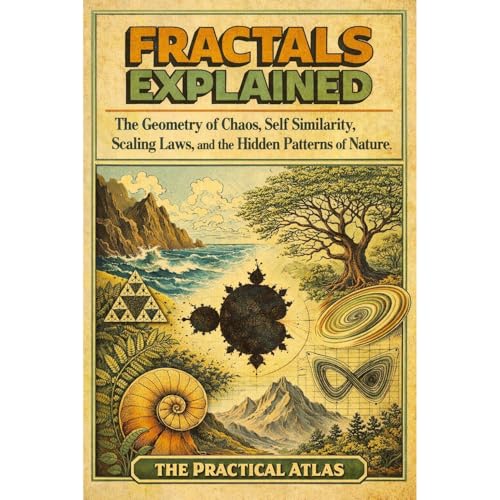
Fractals Explained
The Geometry of Chaos, Self Similarity, Scaling Laws, and the Hidden Patterns of Nature
No se pudo agregar al carrito
Add to Cart failed.
Error al Agregar a Lista de Deseos.
Error al eliminar de la lista de deseos.
Error al añadir a tu biblioteca
Error al seguir el podcast
Error al dejar de seguir el podcast
Obtén 30 días de Standard gratis
Compra ahora por $3.99
-
Narrado por:
-
Virtual Voice

Este título utiliza narración de voz virtual
Fractals Explained: The Geometry of Chaos, Self Similarity, Scaling Laws, and the Hidden Patterns of Nature explores one of the most fascinating revolutions in modern mathematics and science. From the jagged outline of coastlines to the branching of trees and the structure of the human lung, fractals reveal that nature is built on repeating patterns that echo across scales. This book introduces readers to fractal geometry in clear, accessible language while preserving the depth and rigor that make the subject so powerful. If you have ever wondered how simple equations can generate infinite complexity, or how chaos and order can coexist within the same system, this guide will open your eyes to a new way of seeing the world.
Inside, you will discover how self similarity and scaling laws transform traditional geometry into a dynamic language for describing roughness and irregularity. The book explains fractal dimension and how it measures complexity beyond whole number dimensions. It explores the Mandelbrot set and Julia sets, showing how iteration in the complex plane creates breathtaking structures of endless depth. You will also learn how fractals connect to chaos theory, strange attractors, and nonlinear systems that shape weather, ecosystems, and even financial markets.
Beyond mathematics, Fractals Explained demonstrates how fractal patterns appear throughout biology, from branching blood vessels and lungs to neural networks in the brain. It examines fractals in modern technology, including network science, data modeling, and antenna design. The book also dives into fractal art and digital creativity, revealing how mathematics becomes visual expression through color, recursion, and infinite zoom. By combining scientific insight with real world applications, this guide bridges theory and practice in a way that is engaging and intellectually rewarding.
Whether you are a curious reader, a student of mathematics, a science enthusiast, or a creative thinker drawn to the beauty of complex patterns, this book provides a comprehensive introduction to the geometry of chaos. Fractals are not abstract curiosities. They are the hidden shapes of nature, embedded in landscapes, living systems, and dynamic processes. Once you understand fractal thinking, you will never look at clouds, coastlines, or branching trees the same way again.
FROM THE HALF HOUR HELP SERIES OF BOOKS
The Half Hour Help Series is a collection of concise, practical guides designed to teach the basics of a subject or provide quick solutions to everyday problems. Each book is crafted to be read in about 30 minutes, making it ideal for busy readers who want to learn something new or solve a specific issue without wading through lengthy manuals or complex jargon.
Whether you're looking to understand a new concept, develop a skill, or tackle a challenge, these guides break things down into simple, actionable steps.
Focused on clarity and efficiency, the Half Hour Help Series covers a wide range of topics—from personal development and productivity to science and technology, wellness, culture, and beyond.
Every title is built around the idea that a little help can go a long way, and with just half an hour, readers can gain valuable insights and confidence to move forward.
It's smart support when you need it, without the fluff.