

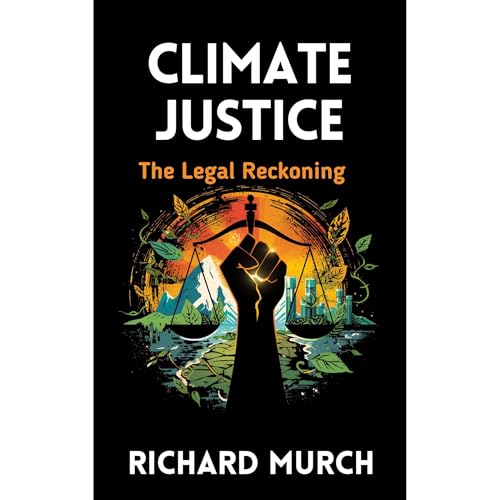
Climate Justice, the Legal Reckoning
and the Fight for a Livable World
No se pudo agregar al carrito
Solo puedes tener X títulos en el carrito para realizar el pago.
Add to Cart failed.
Por favor prueba de nuevo más tarde
Error al Agregar a Lista de Deseos.
Por favor prueba de nuevo más tarde
Error al eliminar de la lista de deseos.
Por favor prueba de nuevo más tarde
Error al añadir a tu biblioteca
Por favor intenta de nuevo
Error al seguir el podcast
Intenta nuevamente
Error al dejar de seguir el podcast
Intenta nuevamente
Prueba gratis de 30 días de Audible Standard
Selecciona 1 audiolibro al mes de nuestra colección completa de más de 1 millón de títulos.
Es tuyo mientras seas miembro.
Obtén acceso ilimitado a los podcasts con mayor demanda.
Plan Standard se renueva automáticamente por $8.99 al mes después de 30 días. Cancela en cualquier momento.

Climate Justice, the Legal Reckoning
Narrado por:
Virtual Voice
Compra ahora por $9.00
-
Narrado por:
-
Virtual Voice
-
De:
-
Richard Murch

Este título utiliza narración de voz virtual
Voz Virtual es una narración generada por computadora para audiolibros..
The charges are as clear as they are damning: a century of industrial extraction, the deliberate suppression of cleaner alternatives, and the calculated externalization of costs onto those who bear the least responsibility for them.
This book is not a scientific treatise, though science saturates every page. It is not a legal brief, though the law runs like a spine through its arguments. It is, at its core, a reckoning — an attempt to hold in a single frame the magnitude of what has been done to our shared planet and the profound injustice of who has been made to pay the price.
"Climate change is not an equal-opportunity catastrophe."
The word justice appears in our title deliberately and without apology. For too long, the conversation about climate has been dominated by the language of science and economics — carbon parts per million, discount rates, marginal abatement costs — while the moral dimensions have been shuffled to the margins. Yet the central reality of the climate crisis is one of profound moral violation: those who have contributed least to the problem suffer most from its consequences.
The smallholder farmer in Bangladesh whose land disappears beneath rising seas has emitted, across a lifetime, a fraction of what a single transatlantic flight releases. The Indigenous communities watching their ancestral waters vanish built no refineries, funded no think tanks, and wrote no op-eds insisting that the science was uncertain. They simply lived — and now they are asked to lose everything.
This foreword is not the place to lay out the full anatomy of that injustice. That is what the chapters ahead are for. But it is the place to say, plainly, what this book believes: that the climate crisis is not merely an environmental emergency. It is one of the defining moral failures of our age, a slow-motion crime whose perpetrators are largely insulated from its consequences and whose victims had almost no say in the decisions that sealed their fate.
Todavía no hay opiniones