

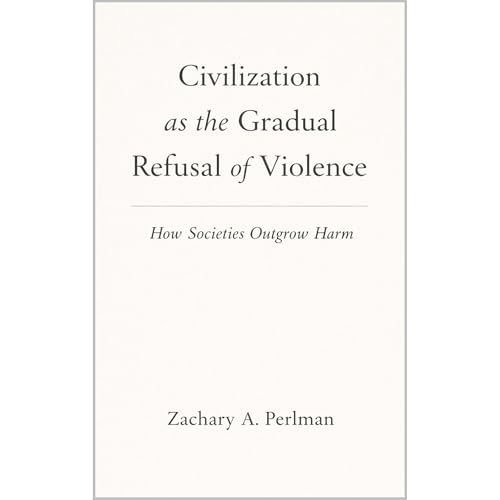
Civilization as the Gradual Refusal of Violence
How Societies Outgrow Harm
No se pudo agregar al carrito
Add to Cart failed.
Error al Agregar a Lista de Deseos.
Error al eliminar de la lista de deseos.
Error al añadir a tu biblioteca
Error al seguir el podcast
Error al dejar de seguir el podcast
 Exclusivo para miembros Prime: ¿Nuevo en Audible? Obtén 2 audiolibros gratis con tu prueba.
Civilization as the Gradual Refusal of Violence
Compra ahora por $4.99
-
Narrado por:
-
Virtual Voice
-
De:
-
Zachary Perlman

Este título utiliza narración de voz virtual
Civilization is often described as humanity’s triumph over violence. Yet much of what modern life depends upon still requires harm—often hidden, procedural, or framed as unavoidable.
Civilization as the Gradual Refusal of Violence proposes a different way of understanding moral progress. Rather than treating civilization as a finished state or a set of institutions, it frames civilization as a direction of travel: a slow, uneven movement away from killing, coercion, and domination as default tools for solving problems.
Drawing on history, ethics, and systems thinking, the book traces a recurring pattern. Practices once defended as necessary—slavery, public cruelty, torture, child labor—did not disappear because humanity became morally perfect, but because intelligence learned how to redesign society so that these harms were no longer required. Violence receded not through purity or ideology, but through alternatives.
Seen through this lens, many contemporary practices appear not as moral failures, but as unfinished designs. Food systems, punishment, labor, and extraction are examined as domains where violence persists less because it is inevitable than because it has not yet been fully reimagined.
This book is not a manifesto, a policy proposal, or a call to action. It does not demand immediate solutions or moral conformity. Instead, it offers a quiet framework for noticing how civilizations change—by gradually reducing what they need to do in order to function.
Written in a calm, reflective style, Civilization as the Gradual Refusal of Violence is intended for readers interested in ethics, social philosophy, and the long-term development of human societies. It is a book to be read slowly, considered carefully, and returned to over time.