

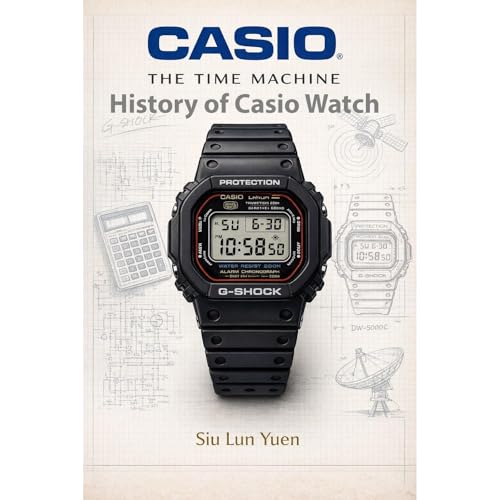
Casio
The Time Machine- History Of Casio Watch
No se pudo agregar al carrito
Add to Cart failed.
Error al Agregar a Lista de Deseos.
Error al eliminar de la lista de deseos.
Error al añadir a tu biblioteca
Error al seguir el podcast
Error al dejar de seguir el podcast
Obtén 30 días de Standard gratis
Compra ahora por $3.99
-
Narrado por:
-
Virtual Voice
-
De:
-
Siu Lun Yuen

Este título utiliza narración de voz virtual
CASIO — THE TIME MACHINE
History Of Casio Watch
From Casiotron to G-Shock Nation: A Time Machine History
By Siu Lun Yuen
What if a watch did more than tell time?
What if it calculated it, resisted it, and ultimately redefined it?
In CASIO — THE TIME MACHINE, Siu Lun Yuen traces the extraordinary journey of a company that began not as a watchmaker, but as a calculator manufacturer—and went on to reshape the meaning of timekeeping for the modern world.
Starting with the groundbreaking Casiotron of 1974, the world’s first digital watch with an automatic calendar, this book explores how Casio approached time not as something to display, but as something to compute. That single shift in thinking laid the foundation for a new kind of watchmaking—one driven not by tradition, but by engineering logic.
From there, the story unfolds across five decades of relentless innovation. The birth of the G-Shock in 1983, conceived from a simple yet radical idea—“a watch that never breaks”—marked a turning point. What followed was not just a product line, but a global phenomenon: a watch trusted by soldiers, adopted by skateboarders, embraced by musicians, and worn by millions who valued function over form—and then discovered that function could become form.
This book is not merely a catalogue of models. It is a study of systems thinking. Each chapter reveals how one solution led to another:
• Auto-calendar revealed the limits of accuracy
• Radio-controlled timekeeping solved precision but exposed coverage gaps
• Solar power extended autonomy while redefining energy constraints
• GPS and connectivity reconnected the watch to the world
Through these transitions, Casio did not follow the conventions of Swiss watchmaking—it built a parallel philosophy, one rooted in electronics, miniaturisation, and mass accessibility.
Alongside technical evolution, The Time Machine explores Casio’s cultural impact. From the streets of 1980s California to Tokyo’s fashion districts and global digital communities, the same watch appears again and again—adapted, reinterpreted, but fundamentally unchanged. It is this continuity that defines Casio’s unique place in design history: a product that evolves without losing its identity.
At its core, this is a story about persistence. About engineers who refused to accept that watches had to break. About a company that believed precision could be democratic. And about a simple idea—time as calculation—that continues to unfold.
For watch enthusiasts, designers, engineers, and curious readers alike, CASIO — THE TIME MACHINE offers a rare perspective: not just how watches are made, but how ideas endure.
Because in the end, the most remarkable thing about Casio is not what it created—
but how it kept creating, without ever needing to start over.