

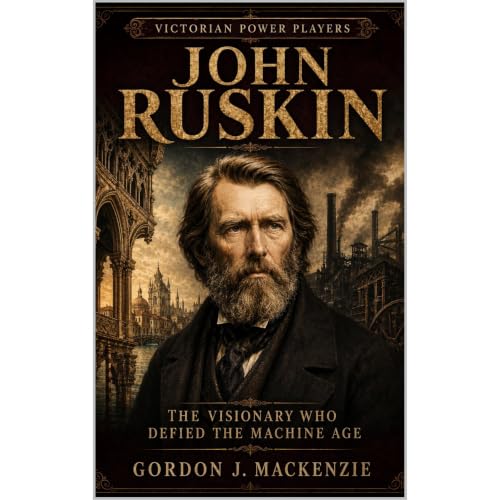
John Ruskin
The Visionary Who Defied the Machine Age
No se pudo agregar al carrito
Add to Cart failed.
Error al Agregar a Lista de Deseos.
Error al eliminar de la lista de deseos.
Error al añadir a tu biblioteca
Error al seguir el podcast
Error al dejar de seguir el podcast
Obtén 30 días de Standard gratis

John Ruskin
Compra ahora por $11.99
-
Narrado por:
-
Virtual Voice

Este título utiliza narración de voz virtual
He began by defending great art. He ended by putting the entire industrial age on trial.
John Ruskin was one of the most extraordinary and contradictory minds of Victorian Britain: art critic, social reformer, teacher, conservationist, economic dissenter and moral prophet.
Born into wealth in 1819, Ruskin was raised among books, religion, art and extensive travel. While still in his twenties, his passionate defence of J. M. W. Turner in Modern Painters established him as one of Britain's most influential cultural critics. But paintings were only the beginning. Ruskin increasingly believed that art could not be separated from the society that produced it. Architecture revealed attitudes toward labour. Cities revealed national priorities. Wealth itself was meaningless unless it enriched human life.
From the Gothic architecture of Venice to the factories and crowded cities of industrial Britain, Ruskin challenged a civilisation that measured progress through production, profit and speed. In Unto This Last, he attacked conventional political economy and insisted that the true purpose of an economy was not simply to create wealth, but to create lives worth living.
His influence reached far beyond art criticism. William Morris and the Arts and Crafts movement transformed his ideas about craftsmanship and labour. Social reformers drew upon his attacks on inequality and industrial degradation. Mahatma Gandhi discovered in Ruskin a vision of work, community and human welfare that would influence his own political and social philosophy.
Yet Ruskin's private life was filled with painful contradictions. His disastrous marriage to Effie Gray ended in annulment and public scandal. His later attachment to Rose La Touche became another source of controversy and grief. Mental illness eventually brought repeated breakdowns and increasing withdrawal from public life. The moral critic capable of exposing hidden forms of domination in society could struggle to recognise them within his own relationships.
John Ruskin: The Visionary Who Defied the Machine Age follows Ruskin from his protected childhood and Oxford education through Turner, Venice, the Pre-Raphaelites, Effie Gray, Unto This Last, the Guild of St George, the Whistler trial, Brantwood and his remarkable intellectual afterlife.
Ruskin did not defeat industrial civilisation. Instead, he left it with a question that remains unsettlingly modern: What is the value of economic progress if it diminishes the quality of human life?
Part of the Victorian Power Players series - the remarkable lives that shaped the modern age.