

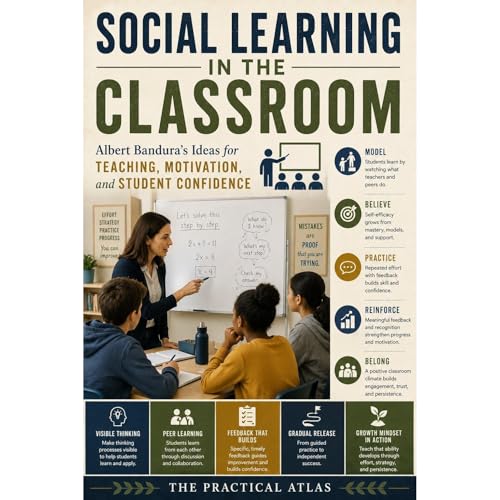
Social Learning in the Classroom
Albert Bandura’s Ideas for Teaching, Motivation, and Student Confidence
No se pudo agregar al carrito
Add to Cart failed.
Error al Agregar a Lista de Deseos.
Error al eliminar de la lista de deseos.
Error al añadir a tu biblioteca
Error al seguir el podcast
Error al dejar de seguir el podcast
Obtén 30 días de Standard gratis

Social Learning in the Classroom
Compra ahora por $3.99
-
Narrado por:
-
Virtual Voice

Este título utiliza narración de voz virtual
Social Learning in the Classroom: Albert Bandura’s Ideas for Teaching, Motivation, and Student Confidence explains how students learn from what they see, attempt, repeat, and come to believe about themselves. Rather than treating learning as a matter of explanation alone, the book shows how modeling, attention, memory, practice, and feedback shape everyday classroom outcomes. It is written for teachers, instructional coaches, school leaders, and education students who want a practical account of Bandura’s ideas without abstract jargon.
The book focuses first on observational learning in real teaching situations. It explains why a worked example often teaches more than a verbal reminder, how think-alouds make hidden processes visible, and why students copy not only academic strategies but also attitudes toward mistakes, challenge, and effort. It looks closely at teacher modeling, peer modeling, and the influence of classmates on participation, reading habits, problem solving, and persistence. It also addresses the social side of learning: what students notice about status, belonging, competence, and who gets recognized in the room.
A central theme is self-efficacy, Bandura’s concept for the belief that success is possible through action, strategy, and practice. The book shows how that belief develops from mastery experiences, credible models, specific feedback, and manageable challenge. It examines the difference between encouragement that builds competence and praise that sounds empty, the role of emotional climate in risk-taking, and the ways routines can either strengthen independence or increase hesitation. Teachers will find concrete guidance on helping unsure students attempt difficult work, recover after errors, and build confidence from genuine progress rather than reassurance alone.
The later material connects these ideas to lesson design, classroom culture, and behavior. It explores visible thinking, guided practice, peer learning, self-regulation, and the gradual release of responsibility. It also considers how expectations, consequences, and classroom norms teach students what is possible, what is valued, and how much control they have over improvement. For educators working in elementary, middle, secondary, or teacher education settings, this is a clear and usable guide to Bandura’s relevance for motivation, engagement, confidence, and day-to-day teaching.
FROM THE HALF HOUR HELP SERIES OF BOOKS
The Half Hour Help Series is a collection of concise, practical guides designed to teach the basics of a subject or provide quick solutions to everyday problems. Each book is crafted to be read in about 30 minutes, making it ideal for busy readers who want to learn something new or solve a specific issue without wading through lengthy manuals or complex jargon.
Whether you're looking to understand a new concept, develop a skill, or tackle a challenge, these guides break things down into simple, actionable steps.
Focused on clarity and efficiency, the Half Hour Help Series covers a wide range of topics—from personal development and productivity to science and technology, wellness, culture, and beyond.
Every title is built around the idea that a little help can go a long way, and with just half an hour, readers can gain valuable insights and confidence to move forward.
It's smart support when you need it, without the fluff.