

Jet Cards & Charter Flights: Are You Flying with the Right Operator?
No se pudo agregar al carrito
Add to Cart failed.
Error al Agregar a Lista de Deseos.
Error al eliminar de la lista de deseos.
Error al añadir a tu biblioteca
Error al seguir el podcast
Error al dejar de seguir el podcast

Jet Cards & Charter Flights: Are You Flying with the Right Operator?
-
Narrado por:
-
De:
Send us Fan Mail
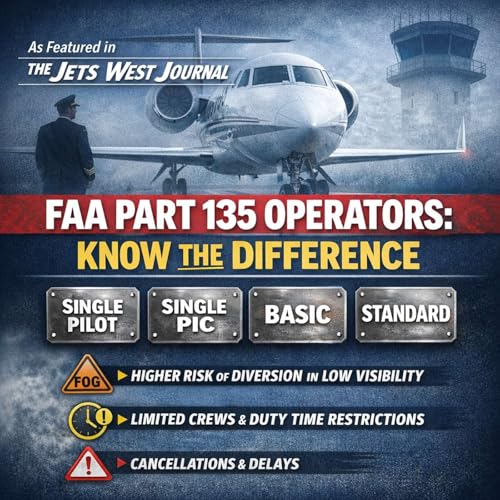
An interesting article in a recent edition of The Jets West Journal published by Jets West reveals that when chartering a private jet or purchasing a jet card, the specific type of FAA Part 135 operator flying your mission can drastically impact your travel experience, particularly regarding potential delays, cancellations, and diversions. The FAA categorizes Part 135 operations into four distinct scopes: Single Pilot, Single Pilot in Command (PIC), Basic, and Standard. Each scope dictates strict limitations on the size of the aircraft, the number of pilots, and the geographical areas of operation. Crucially, operators under Single PIC and Basic certificates are prohibited from performing Category II or Category III instrument approaches, meaning you face a much higher chance of being diverted in low-visibility conditions like fog. Furthermore, understanding these categories is vital because smaller operators with limited pilot rosters may struggle to recover your trip if a pilot falls ill or hits their strict 14-hour duty limit and mandatory 10-hour rest requirements. Ultimately, knowing the difference between these regulatory scopes can help you avoid unexpected delays, last-minute aircraft requotes, and hidden costs.
Subject Lines
The 4 Types of Part 135 Operators (And Why They Matter for Your Next Flight)
Why Your Private Jet Might Divert in the Fog: The Limits of Part 135
Jet Cards & Charter Flights: Are You Flying with the Right Operator?