

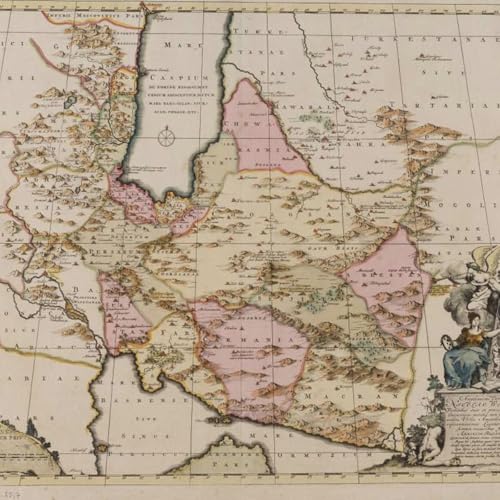
S8 Ep752: SCHEDULE JOHN BATCHELOR SHOW, 4-15-2026. 1705 PERSIAN EMPIRE
No se pudo agregar al carrito
Add to Cart failed.
Error al Agregar a Lista de Deseos.
Error al eliminar de la lista de deseos.
Error al añadir a tu biblioteca
Error al seguir el podcast
Error al dejar de seguir el podcast

S8 Ep752: SCHEDULE JOHN BATCHELOR SHOW, 4-15-2026. 1705 PERSIAN EMPIRE
-
Narrado por:
-
De:
SCHEDULE JOHN BATCHELOR SHOW, 4-15-2026.
1705 PERSIAN EMPIRE
1. Captain James Fanell discusses Iran using Chinese commercial satellites for targeting US bases. He notes the US Navy's successful and complete blockade of the Strait of Hormuz to pressure Tehran's oil economy.
2. General Blaine Holt suggests China may have allowed its satellite technology transfer to Iran to be discovered. He highlights the US Air Force's successful air campaign doctrine and impressive technological capabilities.
3. Steve Yates analyzes Taiwan's security, noting that Beijing should be deterred by US displays of capability in Venezuela and Iran. He observes Taiwanese skepticism toward CCP dialogue and peace overtures.
4. Steve Yates critiques China's unsustainable plan to subsidize tech sectors to revive its economy. He highlights the strategic importance of Taiwan's semiconductor industry and its shift away from Mainland market investments.
5. Mary Kissel reports on ceasefire talks between Israel and Hezbollah at the State Department. She discusses the US Navy's blockade on Iran and regional support for neutralizing Tehran's long influence.
6. Mary Kissel examines the stalling of Venezuela's transition by the Rodriguez family. She notes a significant regional shift toward right-of-center, pro-US governments in South America, including Brazil, Chile, and Colombia.
7. Annie Fixler details Iranian cyber strikes against critical infrastructure, including Jordanian wheat silos and US medical firms. She explains how Tehran pairs digital attacks with psychological operations to maximize disruption.
8. Annie Fixler warns of sophisticated cyber threats from China and Russia. She highlights the danger of AI discovering software vulnerabilities and China's Volt Typhoon prepositioning within US critical infrastructure.
9. Colonel Jeff McCausland assesses the Strait of Hormuz blockade and China's military resupply of Iran. He notes Vladimir Putin's strategic losses in Ukraine and the impact of Viktor Orbán's electoral defeat.
10. Colonel Jeff McCausland discusses the stalling of Venezuela's transition by the Rodriguez family. He questions if oil production can increase quickly enough to impact US gas prices before Labor Day.
11. Jack Burnham warns about security risks in Huawei, ZTE, and Hikvision equipment. He notes Hikvision's role in the Uyghur genocide and the export of surveillance technology to various authoritarian regimes.
12. Jack Burnham explains how Iran leveraged a Chinese commercial satellite for precise military strikes on US targets. He warns that rogue nations can now easily purchase advanced orbital capabilities off-the-shelf.
13. Michael Bernstam explains why the Strait of Hormuz blockade has not caused an oil price spike, citing diverted pipelines in Saudi Arabia and the UAE. He notes China's impending shortfall due to the blockade.
14. Michael Bernstam details Russia's exhausted budget deficit and declining oil production caused by sanctions and technological backwardness. He highlights Viktor Orbán's electoral defeat as a major democratic victory for the EU.
15. Ken Croswell describes the landmark discovery of a lone black hole in the Milky Way. Using the Hubble Space Telescope, astronomers identified this massive object by its gravitational effect on light.
16. Ken Croswell calculates that a black hole likely exists within fifty light-years of Earth. He reassures that the galaxy's vastness makes a catastrophic encounter with our solar system extremely unlikely.