

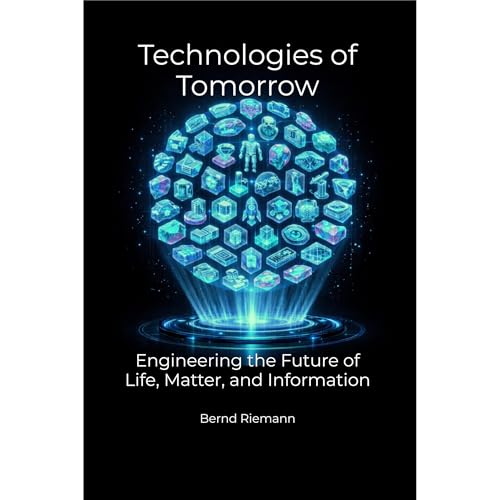
Technologies of Tomorrow
Engineering the Future of Life, Matter, and Information
No se pudo agregar al carrito
Add to Cart failed.
Error al Agregar a Lista de Deseos.
Error al eliminar de la lista de deseos.
Error al añadir a tu biblioteca
Error al seguir el podcast
Error al dejar de seguir el podcast
Obtén 30 días de Standard gratis
Compra ahora por $4.99
-
Narrado por:
-
Virtual Voice
-
De:
-
Bernd Riemann

Este título utiliza narración de voz virtual
The complexity of modern innovation is categorized into three fundamental ontological domains:
Part I: The Future of Life.
The biological sciences have shifted from observation to predictive engineering. We now manipulate genetics, create complex structures, and interface with neural systems, marking a new era in the Anthropocene where environment becomes a platform for innovation. This 33-chapter work covers key mechanisms driving this change, starting with genomic editing and synthetic biology for eradicating hereditary diseases and advancing vaccines. It then explores regenerative medicine, including 3D-printed tissues and xenotransplantation to address organ shortages. Riemann examines the industrialization of life, focusing on CRISPR-Cas9, mRNA platforms, and engineering tissues and neural interfaces. Discussions include senolytic therapies, synthetic wombs, and approaches to extend lifespan and cognitive capacity. Part I underscores that shaping our future depends on deliberate engineering of biological systems, not chance.
Part II: The Future of Matter.
Human progress has reached a definitive transition from the extraction of passive resources to the era of absolute material sovereignty. In this new paradigm, matter is no longer a static constraint but a programmable medium engineered from the atomic level upward. This technological evolution, detailed across thirty-three chapters, centers on the decoupling of industrial growth from environmental degradation through advanced thermophysical engineering. The foundation of this shift lies in the mastery of post-scarcity energy systems, specifically through magnetic confinement fusion and small modular reactors (SMRs). These energy architectures provide the requisite power for a new generation of structural innovations. Breakthroughs in molecular manufacturing and automated assembly—including the synthesis of carbon nanotubes, room-temperature superconductors, and self-healing polymers—enable the creation of previously impossible infrastructure, from ultra-lightweight aerospace frames to carbon-negative urban environments. By integrating these programmable substrates with sustainable energy, we are replacing the physical limitations of the past with an engineered reality defined solely by the laws of physics.
Part III: The Future of Information
The final division of the book addresses the zenith of computational logic and the imperative of informational integrity. As classical limits are reached, the manuscript explores the emergence of fault-tolerant quantum processors and neuromorphic hardware designed to emulate biological efficiency. Riemann delves into the strategic necessity of quantum-resistant cryptography and the decentralized protocols required to maintain sovereignty in a fragmented digital landscape. The work concludes with a technical analysis of long-term archival systems, such as the Svalbard-based digital mirror, ensuring that the human record remains immutable across millennia.
Riemann eschews the simplistic language of contemporary tech journalism in favor of a rigorous, data-driven approach that integrates foundational principles with archival research. Each chapter provides a technical deep-dive into the mechanics of innovation, offering readers a clear understanding of the empirical realities driving global change.