

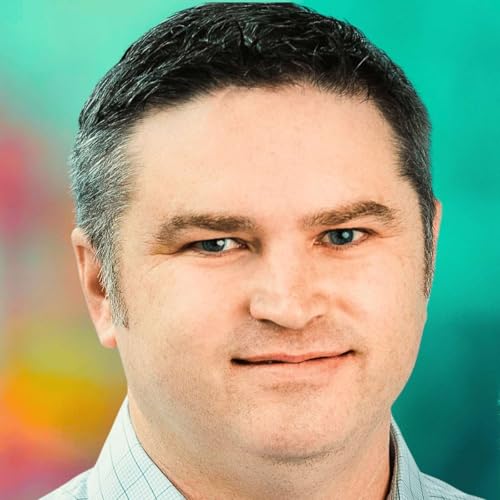
Hugh Broadhurst -- Rare Earth Elements Enabling Sustainability
No se pudo agregar al carrito
Add to Cart failed.
Error al Agregar a Lista de Deseos.
Error al eliminar de la lista de deseos.
Error al añadir a tu biblioteca
Error al seguir el podcast
Error al dejar de seguir el podcast

Hugh Broadhurst -- Rare Earth Elements Enabling Sustainability
-
Narrado por:
-
De:
Hugh Broadhurst is the Chief Operating Officer for Aclara Resources, a company focused on sustainable mining of rare earth minerals, followed by the separation of ionic clays laced with rare earth minerals, and selling these to a host of users, notably electric vehicle makers and others in need of high intensity magnets. Applications for the 17 rare earth elements include electric vehicles, wind turbines, submarines, drones, and robotics... anywhere that electric motors are used.
The conversation begins with a primer on rare earth minerals -- of which there are 160 -- and rare earth elements which number 17. These have been largely sourced from China which currently mines 90% of rare earth minerals and processes over 99% of them, importing minerals from Myanmar and other countries to do so. Aclara is not only developing an alternate supply chain for rare earths, but as Hugh explains, is doing so in a sustainable manner, in line with consumers' expectations.
Hugh joined the podcast from Brazil where Aclara is developing a rare earth mining operation, tapping into ionized clays that can be surface mined, stripped of their valuable elements, before the clays are redeposited on the sites without harmful pollution and disruptive effects. Aclara, a Canadian company, is working in Brazil and Chile on mining operations, while collaborating with Virginia Tech on a separation technique. At the tail end of the company's vertical integration, Aclara is selling refined rare earth element powders, metals, and alloys to manufacturers.
Hugh begins by presenting the value of rare earth mineral for electric vehicles. Their motors depend on high intensity magnets to support their dramatic acceleration. Many magnets lose their magnetism when their temperatures exceed 100 degrees Celsius and EV motors reach temperatures of 150 degrees Celsius (300 degrees Fahrenheit) and thus need special rare earth elements to maintain their magnetism. Two of the 17 rare earth elements are critical for this function: terbium and dysprosium. They are blended into the magnets' formulation at a rate of 2 - 3%. While the cost of these materials for a typical EV is less than $50, Hugh notes that without them, the EV would not function.
Hugh was born and raised in South Africa. His parents were academics and he jokes that his engineering is a genetic disorder he got from his parents, his father an electrical engineer and mother a mathematician. After studying in South Africa, he came to America for graduate school in chemical engineering, before focusing his career on specialty minerals, for semiconductors, for agriculture, lithium for batteries, and at Aclara for magnets.
Rare earths enable the renewable energy revolution he explains. At Aclara, he and his colleagues are proud of doing the right thing in their mining and manufacturers, to meet environmental and ESG standards that people have come to expect. "It's not just what were doing but how we do it."