

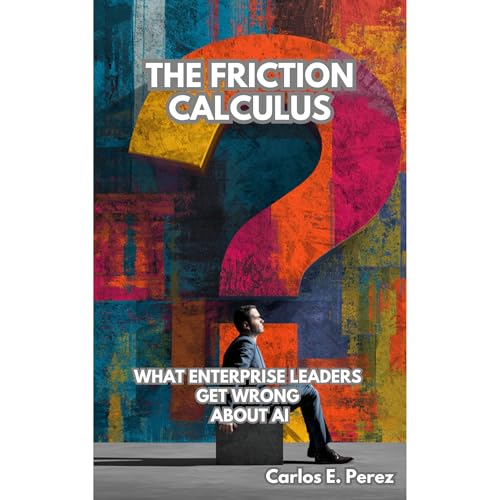
The Friction Calculus
What Enterprise Leaders Get Wrong About AI
No se pudo agregar al carrito
Add to Cart failed.
Error al Agregar a Lista de Deseos.
Error al eliminar de la lista de deseos.
Error al añadir a tu biblioteca
Error al seguir el podcast
Error al dejar de seguir el podcast
Prueba gratis de 30 días de Audible Standard

The Friction Calculus
Compra ahora por $9.95
-
Narrado por:
-
Virtual Voice
-
De:
-
Carlos Perez

Este título utiliza narración de voz virtual
In The Friction Calculus: What Enterprise Leaders Get Wrong About AI — and the One Question That Fixes It, author Carlos E. Perez dismantles the current corporate playbook for artificial intelligence. He reveals a fundamental, structural shift that most companies are entirely missing: AI has made generating content incredibly cheap, but verifying its accuracy remains expensive and irreducibly human. By optimizing for generation instead of verification, enterprises are pouring money into the wrong side of the equation.
Perez paints a vivid picture of the modern enterprise, where highly paid knowledge workers are crippled by the "Integration Tax". Instead of doing high-level strategic thinking, these workers spend 60 to 80 percent of their time acting as "human APIs," manually opening dozens of browser tabs to assemble context across disconnected software silos.
While major software vendors promise to fix this with shiny new AI agents, Perez warns of the "Bowling Shoe Trap." Vendors are building AI agents that work beautifully inside their own closed systems—much like bowling shoes work perfectly in the alley—but are completely blind the moment you need cross-system context to make a real business decision.
To escape this trap, the book introduces a groundbreaking framework centered around one pivotal question: ***"Is this friction protecting us or extracting from us?"***.
Perez argues that in the rush to automate, leaders mistakenly try to eliminate all friction. He categorizes friction into two types:
- Rent-Extracting (Parasitic) Friction: The mindless tab-switching, data assembly, and schema translation that wastes human potential. This must be aggressively automated.
- Load-Bearing Friction: The deliberate deliberation, compliance reviews, and human judgment checks that prevent a company from making catastrophic, machine-speed mistakes. This must be fiercely protected.
Divided into actionable sections for enterprise buyers, startup founders, and venture investors, the book provides a complete strategic roadmap. It outlines "Context Engineering" to properly synthesize data, the "Veeva Playbook" for building highly defensible vertical AI startups, and a step-by-step deployment sequence designed to build organizational trust over time.
The Friction Calculus is not just a book about technology; it is an essential guide to organizational design in the AI era. It challenges leaders to realize that the ultimate goal of AI isn't to replace human judgment, but to clear away the bureaucratic waste so that human judgment can finally take center stage.