

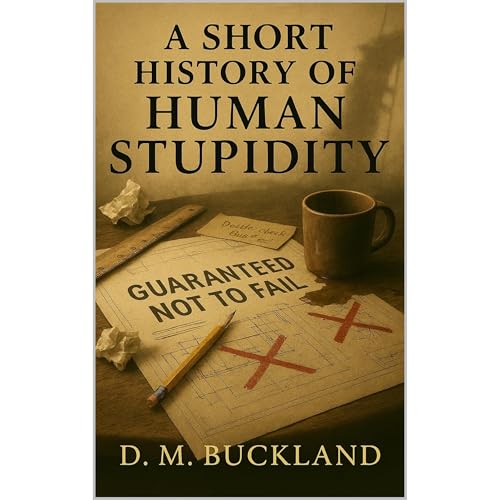
A SHORT HISTORY OF HUMAN STUPIDITY
No se pudo agregar al carrito
Add to Cart failed.
Error al Agregar a Lista de Deseos.
Error al eliminar de la lista de deseos.
Error al añadir a tu biblioteca
Error al seguir el podcast
Error al dejar de seguir el podcast
 Exclusivo para miembros Prime: ¿Nuevo en Audible? Obtén 2 audiolibros gratis con tu prueba.
A SHORT HISTORY OF HUMAN STUPIDITY
Compra ahora por $9.99
-
Narrado por:
-
Virtual Voice
-
De:
-
D. M Buckland

Este título utiliza narración de voz virtual
A Short History of Human Stupidity is a lovingly researched, gleefully irreverent celebration of humanity at its most confident—and most wrong. This is the story of how civilisation was built not just on genius and insight, but on bad ideas pursued with alarming enthusiasm and excellent posture.
From scientists who explained the universe with diagrams that meant absolutely nothing, to doctors who prescribed treatments that made patients immediately regret seeking help, to engineers who stared at a drawing and said, “Yes, gravity will probably be fine,” this book chronicles our greatest hits of historical misjudgement. Along the way you’ll meet explorers who packed everything except common sense, experts who predicted the future with unwavering certainty (and got every detail wrong), and committees that proved many heads are, in fact, worse than one.
But this is not a book about mockery. It’s about affection. Because for all our spectacular errors—misguided theories, disastrous inventions, heroic bureaucratic nonsense, and predictions that aged like milk in direct sunlight—human progress somehow kept happening. Often because of the mistake, not in spite of it. Wrong turns became discoveries. Failures became foundations. Someone ignored the manual, and the modern world happened.
Written with sharp wit and a historian’s curiosity, A Short History of Human Stupidity reminds us that being wrong is not a glitch in the system—it is the system. Intelligence may get the credit, but optimism, overconfidence, and the refusal to admit error did most of the heavy lifting.
Perfect for readers who enjoy laughing at the past, recognising the present, and feeling gently reassured that humanity has always been like this—and will absolutely continue to be.
Because if confidence alone could make ideas work, history would be much shorter.