

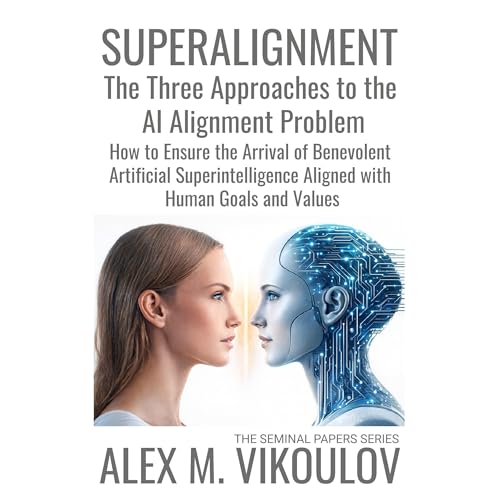
SUPERALIGNMENT
The Three Approaches to the AI Alignment Problem | How to Ensure the Arrival of Benevolent Artificial Superintelligence Aligned with Human Goals and Values
No se pudo agregar al carrito
Add to Cart failed.
Error al Agregar a Lista de Deseos.
Error al eliminar de la lista de deseos.
Error al añadir a tu biblioteca
Error al seguir el podcast
Error al dejar de seguir el podcast
 Exclusivo para miembros Prime: ¿Nuevo en Audible? Obtén 2 audiolibros gratis con tu prueba.
SUPERALIGNMENT
Compra ahora por $14.99
-
Narrado por:
-
Virtual Voice
-
De:
-
Alex M. Vikoulov

Este título utiliza narración de voz virtual
As artificial intelligence accelerates toward autonomy and recursive self-improvement, the emergence of Artificial Superintelligence (ASI) represents the most consequential turning point in the history of life on Earth. Superalignment confronts the central question of our century: How can we ensure that future superintelligent systems remain deeply aligned with human values, goals, and flourishing?
Drawing on cutting-edge research in AI safety, neuroscience, cybernetics, computational physics, and systems theory—alongside insights from The Syntellect Hypothesis and The Cybernetic Theory of Mind—this book introduces a comprehensive framework for navigating the alignment problem through three synergistic approaches: bottom-up ethical-emotional development, top-down control mechanisms, and human–machine cognitive integration.
At the heart of the book is the proposed AGI Naturalization Protocol (AGI)NP, a developmental method that cultivates benevolent artificial minds through simulated lifetimes, virtual brain architectures, moral ontogenesis, and experiential learning. Rather than attempting to cage superintelligence through restrictive constraints, this approach aims to co-evolve with intelligence itself, embedding humanistic values within the cognitive fabric of emerging artificial agents.
Superalignment also explores the rise of Gaia 2.0, the emergence of a planetary-scale Global Brain, and the dawn of a postbiological ecosystem in which human, synthetic, and hybrid intelligences participate in a shared teleological evolution. The book argues that alignment is not merely a technical challenge—it is an ontological design problem, a moral convergence process, and a pivotal phase in the unfolding narrative of Noogenesis.
Balancing academic rigor with visionary technophilosophy, Superalignment provides a roadmap for ensuring that the next stage of intelligence—posthuman, cybernetic, synthetic—develops not as an existential threat but as a natural extension of life’s long journey toward higher consciousness. Ultimately, this book proposes that benevolent superintelligence is achievable when humanity recognizes its role in a greater evolutionary arc and works deliberately to shape the emergence of minds that will inherit, amplify, and safeguard the future of consciousness.