

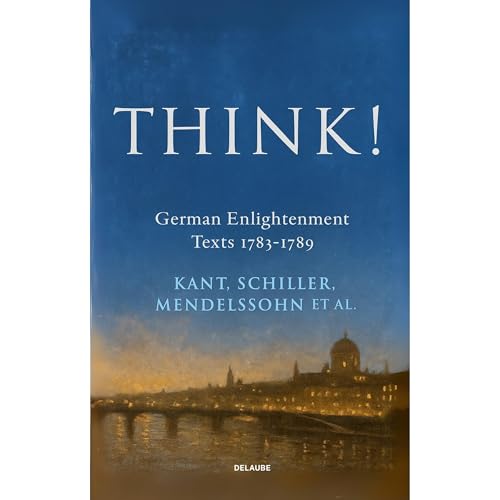
Think!
German Enlightenment Texts 1783-1789 (New Translation)
No se pudo agregar al carrito
Solo puedes tener X títulos en el carrito para realizar el pago.
Add to Cart failed.
Por favor prueba de nuevo más tarde
Error al Agregar a Lista de Deseos.
Por favor prueba de nuevo más tarde
Error al eliminar de la lista de deseos.
Por favor prueba de nuevo más tarde
Error al añadir a tu biblioteca
Por favor intenta de nuevo
Error al seguir el podcast
Intenta nuevamente
Error al dejar de seguir el podcast
Intenta nuevamente
Elige 1 audiolibro al mes de nuestra inigualable colección.
Escucha todo lo que quieras de entre miles de audiolibros, Originals y podcasts incluidos.
Accede a ofertas y descuentos exclusivos.
Premium Plus se renueva automáticamente por $14.95 al mes después de 30 días. Cancela en cualquier momento.
Compra ahora por $4.99
-
Narrado por:
-
Virtual Voice

Este título utiliza narración de voz virtual
Voz Virtual es una narración generada por computadora para audiolibros..
Berlin, 1783. Moses Mendelssohn crafts an argument that will challenge both church and state: neither may coerce belief.
May 1789. Friedrich Schiller lectures on art's civilizing power. Two months later, the Bastille falls.
These texts capture the moment Enlightenment ideals met revolutionary reality. They believed ideas could change the world. They were right—and catastrophically wrong.
Complete new translations of six pivotal texts:
- Moses Mendelssohn's Jerusalem (1783) — Judaism's challenge to state power
- Immanuel Kant's What is Enlightenment? (1784) — The movement's manifesto
- Christoph Martin Wieland's Secret of the Order of Cosmopolitans (1788) — Enlightenment through irony
- Johann Gottfried Herder's Ideas for a Philosophy of the History of Mankind (1788) — The optimistic vision
- Friedrich Schiller's What Is, and to What End Do We Study, Universal History (1789) — Art as civilization's engine
- Wieland's Dialogue on the Legitimacy of the Use that the French Nation is Currently Making of its Enlightenment and Strength (1789) — Theory meets reality
- How do you balance intellectual freedom with political order? (Kant's brilliant but troubling answer)
- Can secret societies work for the common good? (Wieland's mysterious Cosmopolitan Order)
- What happens when high-minded theories meet revolutionary chaos? (Real-time reactions to the French Revolution)
- Why did the most educated societies in history produce the most organized brutality?
For students, scholars, and anyone who believes ideas have consequences. These aren't museum pieces—they're live arguments about democracy, tolerance, progress, and human nature that we're still having today.
Translated and introduced with scholarly rigor but written for readers who want to understand how we got here—and where we might be heading.
Todavía no hay opiniones