

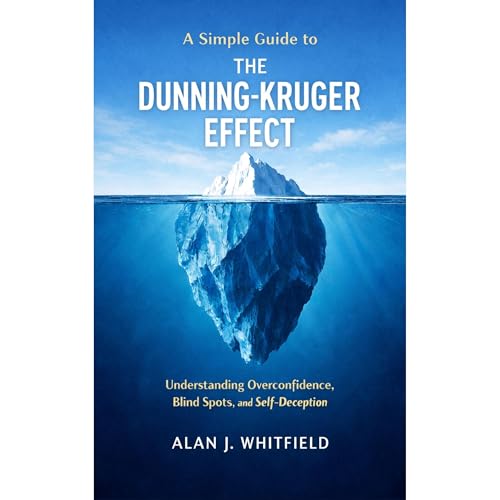
A Simple Guide to The Dunning-Kruger Effect
Understanding Overconfidence, Blind Spots, and Self-Deception
No se pudo agregar al carrito
Add to Cart failed.
Error al Agregar a Lista de Deseos.
Error al eliminar de la lista de deseos.
Error al añadir a tu biblioteca
Error al seguir el podcast
Error al dejar de seguir el podcast

A Simple Guide to The Dunning-Kruger Effect
Compra ahora por $9.99
-
Narrado por:
-
Virtual Voice

Este título utiliza narración de voz virtual
Confidence feels good. It feels convincing. And very often, it’s wrong.
If you’ve ever wondered why people with the least experience speak with the most certainty—or why smart, capable individuals still make baffling mistakes—you’re already brushing up against the Dunning-Kruger Effect. This book explains it clearly, calmly, and without academic fog.
A Simple Guide to The Dunning-Kruger Effect reveals how confidence can outpace competence, how blind spots form without our awareness, and how self-deception quietly shapes decisions at work, online, and in everyday life. The result is a clearer understanding of why judgment so often goes astray—and how to recognize it before it costs you.
Inside this book, you’ll discover:
• Why feeling sure is not the same as being right
• How limited knowledge creates inflated self-belief
• Why feedback often fails to correct overconfidence
• How social reinforcement makes false certainty spread
• Why expertise usually sounds less confident, not more
Written for general readers, not psychologists, this book strips the Dunning-Kruger Effect down to its essentials. It connects research to real-world behavior, showing how this bias plays out in leadership, public debate, social media, and personal decision-making. The tone is sharp but fair, insightful without being accusatory.
You’ll come away with more than an explanation of a famous bias. You’ll gain a way to think about confidence itself—when to trust it, when to question it, and why certainty should often be treated as a signal to slow down rather than speed up.
If you value clear thinking, honest self-assessment, and better judgment in a noisy, overconfident world, this book belongs on your shelf.
Scroll up and order your copy of A Simple Guide to The Dunning-Kruger Effect today—and start seeing confidence for what it really is.