

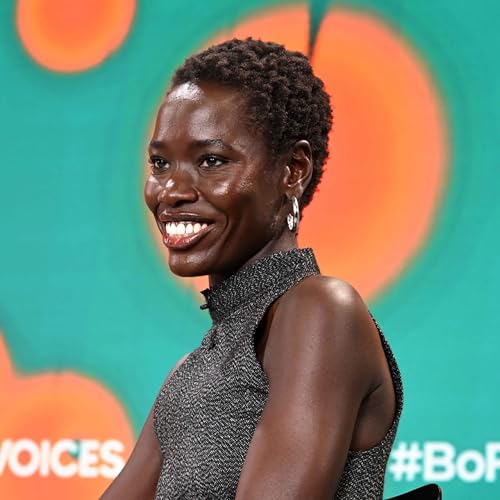
Awar Odhiang on Joy, Inclusion and Her Viral Chanel Moment
No se pudo agregar al carrito
Add to Cart failed.
Error al Agregar a Lista de Deseos.
Error al eliminar de la lista de deseos.
Error al añadir a tu biblioteca
Error al seguir el podcast
Error al dejar de seguir el podcast

Awar Odhiang on Joy, Inclusion and Her Viral Chanel Moment
-
Narrado por:
-
De:
Born to South Sudanese parents and raised in Canada after arriving as refugees in 2002, Awar Odhiang grew up far from fashion’s orbit. She was studying health sciences and planning a career in medicine, when she was scouted at her first job. Her career began locally in Calgary, then accelerated fast after she launched internationally in 2019 — with early runway breaks, a packed show schedule and global campaigns. Then came the moment that stopped the industry when she closed the most-watched debut of the season at Matthieu Blazy’s Chanel show in October.
“The moment that really allowed me to fill that space in that way was the freedom that I was given, truly,” she says. Backstage, Matthieu Blazy, Chanel’s new creative director encouraged her to own the moment. “I just felt so free, so confident, so beautiful. You can tell Matthieu loves women just by his designs.”
In this conversation from BoF VOICES 2025, I speak with Awar about the gap between being celebrated publicly and understood privately, why inclusion has to extend to behind the camera and the boundaries she is setting to protect her sense of joy in an industry that rarely slows down.
Key Insights:
- Odhiang recounts meeting agent Kelly Streit whilst working her first job in retail and her scouting story captures a pivotal shift in self-belief. “That was a moment that now I can look back at and realise that he believed in me before I even believed in myself,” she says. From folding sweaters at Old Navy to international runways by 2019, she frames the leap as an intentional decision to embrace an unexpected opportunity.
- As a high profile dark skinned model, her growing visibility hasn’t eliminated her feelings of isolation. “One of the darker sides of modelling I would say is really the [lack of] inclusion … the fact that we’re still talking about this today really shows how big of a problem that is.” She defines inclusivity as being allowed to be at ease rather than just token representation: “For me, inclusion is being able to be in a room and not have to translate yourself … where you’re not the only person who looks like you, where you’re not the only person who’s expected to speak on certain matters.”
- Moreover, whilst diverse campaigns can signal progress, backstage the culture still lags behind. “Being welcomed publicly and being understood privately —. I think they’re two very different things,” Odhiang says. “A lot of it [is] performative … behind the scenes there’s no diversity. There’s nobody who’s really understanding you, your story, how you’ve been treated. So that’s really dismissed a lot.” Her call is for decision-room diversity, consistency rather than trends, and respect for lived experiences.
- As attention intensifies, Odhiang is resolute about boundaries and community. “I would protect this joy, this joy in my heart, this joy of my soul, by continuing to set boundaries … by also keeping the company around me honest and close, and by also not allowing the pace of the industry to impact the pace of me as a human,” she says. For her, sustainability is emotional as much as professional — maintaining a human tempo amid fashion’s demands.
Additional Resources:
- Awar Odhiag | BoF 500
- Awar Odhiang: Choosing Joy
Hosted on Acast. See acast.com/privacy for more information.