

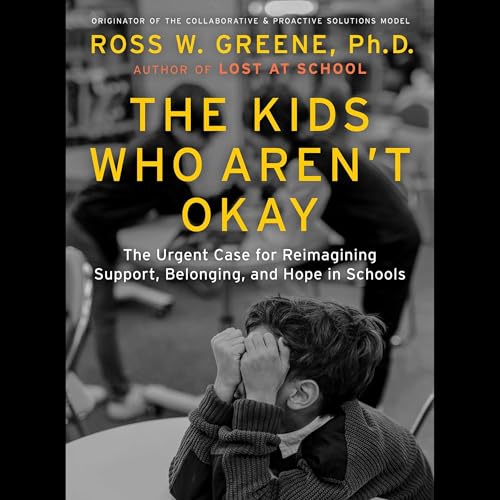
The Kids Who Aren't Okay
The Urgent Case for Reimagining Support, Belonging, and Hope in Schools
No se pudo agregar al carrito
Solo puedes tener X títulos en el carrito para realizar el pago.
Add to Cart failed.
Por favor prueba de nuevo más tarde
Error al Agregar a Lista de Deseos.
Por favor prueba de nuevo más tarde
Error al eliminar de la lista de deseos.
Por favor prueba de nuevo más tarde
Error al añadir a tu biblioteca
Por favor intenta de nuevo
Error al seguir el podcast
Intenta nuevamente
Error al dejar de seguir el podcast
Intenta nuevamente
$0.00 por los primeros 30 días
POR TIEMPO LIMITADO
Obtén 3 meses por US$0.99 al mes
La oferta termina el 16 de diciembre de 2025 11:59pm PT.
 Exclusivo para miembros Prime: ¿Nuevo en Audible? Obtén 2 audiolibros gratis con tu prueba.
Solo $0.99 al mes durante los primeros 3 meses de Audible Premium Plus.
1 bestseller o nuevo lanzamiento al mes, tuyo para siempre.
Escucha todo lo que quieras de entre miles de audiolibros, podcasts y Originals incluidos.
Se renueva automáticamente por US$14.95 al mes después de 3 meses. Cancela en cualquier momento.
Elige 1 audiolibro al mes de nuestra inigualable colección.
Escucha todo lo que quieras de entre miles de audiolibros, Originals y podcasts incluidos.
Accede a ofertas y descuentos exclusivos.
Premium Plus se renueva automáticamente por $14.95 al mes después de 30 días. Cancela en cualquier momento.

The Kids Who Aren't Okay
Haz tu pedido de preventa ahora por $14.62
-
Narrado por:
Over the past two decades, a wide array of societal changes have made it much harder to be a kid. While lots of kids are still doing okay, many more than ever are not. The Kids Who Aren’t Okay opens with sobering statistics on children’s mental health: higher than ever rates of concerning behaviors at school, anxiety, depression, chronic absenteeism, and suicidality. And educators—who have never felt less safe at school, have experienced significant decreases in job satisfaction, and have left the profession in droves—aren’t doing very well, either.
Child psychologist Dr. Ross Greene, renowned for his pioneering work in education and originator of the evidence-based Collaborative & Proactive Solutions model (which has transformed practices in countless families, schools, psychiatric units, and residential and juvenile detention settings), has worked in and with schools across the globe for decades. He argues that the moment demands that we renew our focus on developmental variability and meeting every student where they’re at, and that we take a hard look at our structures, practices, and mentalities at school and make practical, actionable, realistic changes that benefit all kids and educators. These changes must include shifting to interventions that are proactive (early) rather than reactive (late), solutions that are collaborative rather than unilateral, and focused on the problems that are causing concerning behaviors (and solving them) rather than behaviors (and modifying them).
Building on the principles introduced in his landmark, bestselling book, Lost at School, Greene equips educators and caregivers with the tools to foster safer, more supportive, inclusive learning environments. In easy-to-understand, practical terms, Greene provides a clear road map for turning things around, complete with vignettes, case studies, and the voices of educators who’ve done it. The Kids Who Aren’t Okay is a vital resource, providing hope and guidance as schools navigate the new normal.
Todavía no hay opiniones