

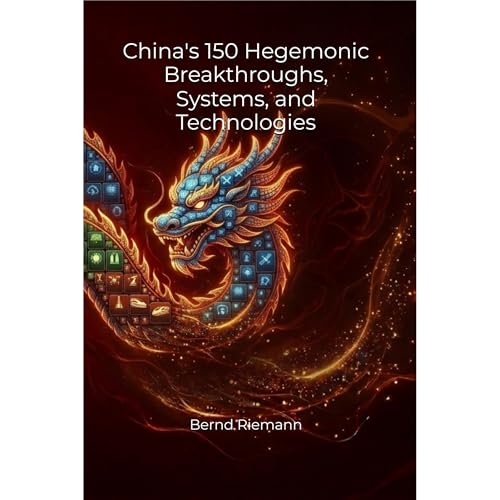
China's 150 Hegemonic Breakthroughs, Systems, and Technologies
No se pudo agregar al carrito
Add to Cart failed.
Error al Agregar a Lista de Deseos.
Error al eliminar de la lista de deseos.
Error al añadir a tu biblioteca
Error al seguir el podcast
Error al dejar de seguir el podcast
Prueba gratis de 30 días de Audible Standard

China's 150 Hegemonic Breakthroughs, Systems, and Technologies
Compra ahora por $14.99
-
Narrado por:
-
Virtual Voice
-
De:
-
Bernd Riemann

Este título utiliza narración de voz virtual
The global framework is undergoing a structural reconfiguration that marks the transition from traditional geopolitical competition to a state of absolute, multi-domain hegemony. This study, China's 150 Hegemonic Breakthroughs, Systems, and Technologies, provides a comprehensive audit of the strategic vectors through which this shift is being realized, moving beyond fragmented technological advancements toward a unified, self-sustaining ecosystem of power. By consolidating the computational brains, the material atoms, the kinetic machinery, and the biological building blocks of the modern era, the state has engineered a condition of systemic dominance that is both technologically unassailable and operationally autonomous. This work examines the deliberate integration of these frontiers—ranging from the quantum-computational stack to the governance of human capital—revealing a blueprint for global leadership that operates independently of Western influence and dictates the future standards of human civilization.
Across 150 critical points of innovation, this volume documents the transition from a labor-intensive manufacturing economy to one predicated on high-value engineering and complex systems integration. The analysis moves through six fundamental pillars:
The Silicon & Quantum Frontier: The mastery of generative AI, exascale computing, and quantum communications that form the cognitive foundation of the future.
The Energy & Material Monopoly: The vertical integration of the global green transition, establishing a strategic bottleneck over the world’s most critical physical inputs.
Advanced Robotics & Kinetic Power: The automation of industrial and strategic output through autonomous swarms, humanoid robotics, and hypersonic propulsion.
Life Sciences & Agricultural Security: The engineering of biological resilience, from CRISPR gene editing to high-tech food sovereignty.
Systems, Governance & Digital Economy: The deployment of the software of society, including sovereign digital currencies and algorithmic urban management.
Soft Power & Human Capital: The cultivation of the world’s largest STEM workforce and the global export of technical and academic standards.
The core of this hegemonic reality lies in the strategic fusion of physical and digital sovereignty. As the following sections illustrate, the mastery of the semiconductor and energy supply chains provides a robust substrate for the deployment of advanced robotics and artificial intelligence, effectively automating the commanding heights of the global economy. This physical monopoly is reinforced by a sophisticated digital and financial operating system, where sovereign digital currencies and algorithmic governance protocols replace decentralized market frictions with real-time, data-driven administrative control. By exporting these standards through the Digital Silk Road, the state creates a global jurisdictional environment that anchors the development of the Global South within a Chinese-centric technical and legal framework.
The durability of this hegemonic project is secured by the cultivation of the human and institutional capital that sustains it. The systematic output of an unparalleled STEM workforce, combined with the global projection of technical and academic norms, ensures a generational lock-in that transcends immediate geopolitical shifts. This study serves as a rigorous documentation of this total integration, demonstrating how the convergence of silicon, quantum, material, kinetic, biological, and social systems forms a singular, coherent apparatus of power. This comprehensive mastery represents the final closure of the technological gap and the establishment of a new era of global governance, where the ability to design the systems, refine the materials, and shape the minds of the future becomes the ultimate instrument of enduring stability.