

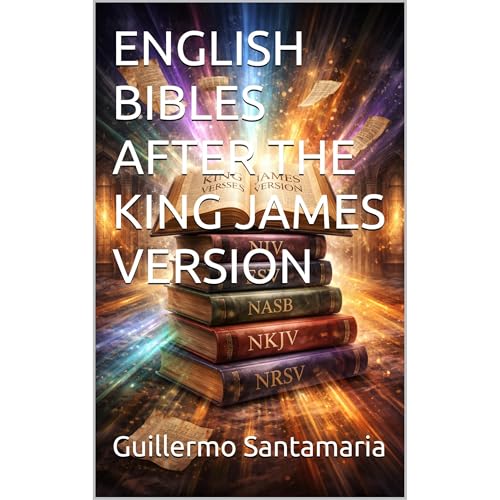
ENGLISH BIBLES AFTER THE KING JAMES VERSION
No se pudo agregar al carrito
Add to Cart failed.
Error al Agregar a Lista de Deseos.
Error al eliminar de la lista de deseos.
Error al añadir a tu biblioteca
Error al seguir el podcast
Error al dejar de seguir el podcast
Prueba gratis de 30 días de Audible Standard

ENGLISH BIBLES AFTER THE KING JAMES VERSION
Compra ahora por $3.99
-
Narrado por:
-
Virtual Voice

Este título utiliza narración de voz virtual
This book argues that the history of English Bibles after the King James Version is not a story of rebellion against Scripture, but a story of readers, churches, and translators wrestling with three stubborn realities: the KJV’s language grew harder for modern readers to understand, the manuscript base available to scholars expanded far beyond what was known in 1611, and different Christian communities needed translations suited to worship, study, evangelism, and ordinary reading. It begins by showing that many modern readers can follow the KJV at a surface level but often stumble over archaic vocabulary, shifted meanings, and older syntax, so that apparent familiarity can hide real misunderstanding. From there it traces the major post-KJV versions in chronological order—from the RV and ASV through the RSV, NIV, NKJV, NLT, ESV, CSB, and NRSVue—explaining what each version was, what translation philosophy shaped it, and why it appeared.
The book then widens the lens beyond simple chronology. It explains the major translation philosophies—formal equivalence, dynamic equivalence, mediating approaches, paraphrase, retelling, and expanded renderings—and shows how paraphrased or freer versions such as J. B. Phillips, The Living Bible, The Message, The Voice, and the Amplified Bible fit into the larger landscape. Finally, it turns to the controversy itself: the KJV-only battle over underlying texts, preservation, inspiration, readability, omitted or disputed verses, doctrinal suspicion, and the authority of tradition. It closes by examining the more conspiratorial explanations often attached to modern translations—Alexandrian corruption, Westcott and Hort as plotters, Vatican or Jesuit influence, New Age infiltration, and end-time apostasy—so that the reader can see not only how English Bibles changed after 1611, but why the debate over those changes became so emotionally charged.
A tighter one-sentence version would be: this book is a historical and theological guide to the English Bible after the King James Version, explaining why new translations arose, how they differ, and why the battle over them became one of the most heated fights in modern Bible culture.