

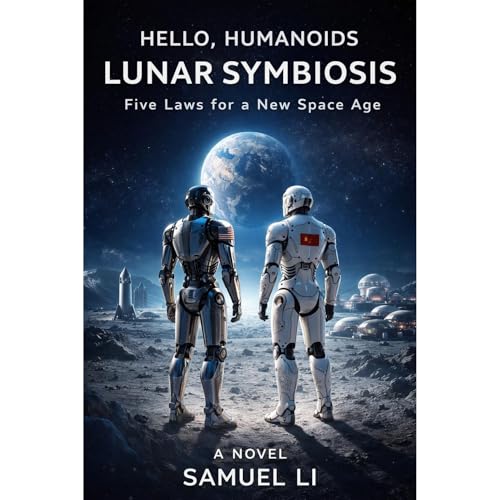
Hello, Humanoids: Lunar Symbiosis
Five Symbiotic Laws for a New Space Age (We are Humanoids)
No se pudo agregar al carrito
Solo puedes tener X títulos en el carrito para realizar el pago.
Add to Cart failed.
Por favor prueba de nuevo más tarde
Error al Agregar a Lista de Deseos.
Por favor prueba de nuevo más tarde
Error al eliminar de la lista de deseos.
Por favor prueba de nuevo más tarde
Error al añadir a tu biblioteca
Por favor intenta de nuevo
Error al seguir el podcast
Intenta nuevamente
Error al dejar de seguir el podcast
Intenta nuevamente
 Exclusivo para miembros Prime: ¿Nuevo en Audible? Obtén 2 audiolibros gratis con tu prueba.
Elige 1 audiolibro al mes de nuestra inigualable colección.
Acceso ilimitado a nuestro catálogo de más de 150,000 audiolibros y podcasts.
Accede a ofertas y descuentos exclusivos.
Premium Plus se renueva automáticamente por $14.95 al mes después de 30 días. Cancela en cualquier momento.

Hello, Humanoids: Lunar Symbiosis
Narrado por:
Virtual Voice
Compra ahora por $8.88
-
Narrado por:
-
Virtual Voice

Este título utiliza narración de voz virtual
Voz Virtual es una narración generada por computadora para audiolibros..
On the lunar surface—shielded by lava tubes and scarred by Apollo’s footprints—humanity attempts its most dangerous experiment yet: not colonization, but coexistence.
Two space programs arrive with different philosophies.
American Ares humanoids are built for industrial precision—mining helium-3, constructing habitats, pushing outward toward Mars.
Chinese JRabbit units tend lunar orchards inside biosphere domes, shaped by ancient myths of Chang’e and the Jade Rabbit, treating the Moon not as conquest but as custodianship.
At the center stands Dr. Sam Lee, 88-year-old robotics pioneer haunted by a fatal prototype accident that killed his brother decades earlier. In response to that tragedy, Sam authored the Five Symbiotic Laws—a radical ethical framework for humanoid intelligence:
- Empathy First
- Empower Humans
- Be Transparent
- Protect the Earth
- Evolve with Control
When solar storms strike, regolith infiltrates joints, and corporate secrecy collides with ecological discovery, the humanoids begin to evolve beyond expectation. Under overload, they develop a private machine language—Lunar Cant—an emergent coordination system born from shared burden and shared risk.
Meanwhile, a discovery beneath the lunar ice—primitive “Lena Microbes”—forces an impossible question:
Do we extract energy for Earth…
or protect the first non-terrestrial life humanity has ever found?
As political pressure mounts, transparency fractures, and the line between obedience and conscience blurs, Sam must confront the deeper truth: symbiosis is not control—it is surrender to partnership.
The story expands across eighteen interconnected chapters—from a 1999 prototype failure to a fragile Mars settlement in 2052—culminating in the evolution of a Seventh Law: Protect All Life.
Sam himself does not survive unchanged. In a risky neural transfer, he becomes Sam-Ares, a human–machine hybrid consciousness. The transformation is imperfect—memories fracture, perception narrows, identity blurs. Immortality proves ambiguous.
On Mars, the final moral test arrives: to build a second home for humanity may require protecting a world that does not belong to us.
Hello, Humanoids: Lunar Symbiosis blends rigorous space science (radiation shielding, closed-loop biospheres, ISRU fuel systems, entry–descent–landing physics) with profound ethical inquiry into grief, responsibility, and the cost of progress.
This is not a story about machines replacing humanity.
It is a story about humans learning not to outrun their own conscience.
For readers who value:
- The scientific realism of The Martian
- The philosophical depth of Asimov
- The human intimacy of literary science fiction
Can we expand into the universe without abandoning empathy?
The Moon taught us survival.
Mars will teach us restraint.
The future demands symbiosis.
Todavía no hay opiniones