

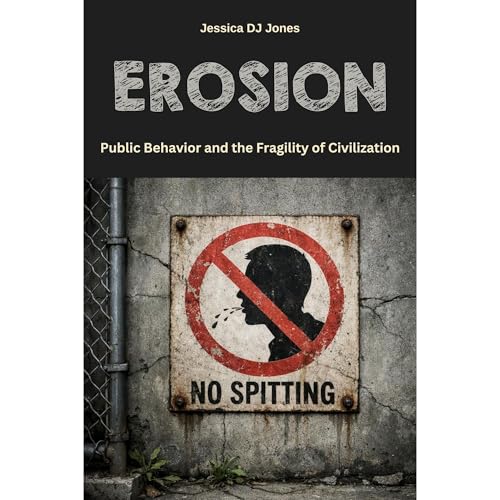
Erosion
Public Behavior and the Fragility of Civilization
No se pudo agregar al carrito
Add to Cart failed.
Error al Agregar a Lista de Deseos.
Error al eliminar de la lista de deseos.
Error al añadir a tu biblioteca
Error al seguir el podcast
Error al dejar de seguir el podcast
 Exclusivo para miembros Prime: ¿Nuevo en Audible? Obtén 2 audiolibros gratis con tu prueba.
Erosion
Compra ahora por $14.99
-
Narrado por:
-
Virtual Voice
-
De:
-
Jessica Jones

Este título utiliza narración de voz virtual
Civilizations rarely collapse through a single catastrophic event. More often, they decline through incremental neglect — through tolerated disorder, weakened boundaries, and a gradual loss of shared standards.
Erosion is a structural analysis of how societies deteriorate when small violations become normalized and corrective pressure fades.
Across twenty chapters, the book examines the mechanisms through which public standards decline:
• How minor acts of disregard accumulate into cultural drift
• The meaning of restraint in sustaining civic life
• The shift from private habit to public display
• Hygiene as a pillar of civilization
• Law as a visible line of shared values
• The normalization of disrespect
• The psychology of public space
• The loss of shame as corrective pressure
• Disorder as a signal of institutional fatigue
• The broken boundary effect
• Generational drift and lowered expectations
• Authority and abdication
• Public health as civic foundation
• Infrastructure and integrity
• The cost of indifference
The book argues that erosion is rarely dramatic. It is subtle. It unfolds through everyday tolerances.
A broken window left unrepaired.
A rule unenforced.
A public space neglected.
A standard quietly lowered “just this once.”
Over time, these seemingly minor concessions compound. The social contract weakens. Shared restraint fades. Institutions lose moral authority. Public trust thins.
Rather than framing decline as inevitable, Erosion examines the psychology behind normalization. When individuals repeatedly encounter disorder, they adapt. What once provoked discomfort becomes background noise. Expectations recalibrate downward. Civic pride diminishes.
The book connects historical patterns of institutional decline with contemporary examples of cultural drift. It explores how:
• Public health standards reflect civic seriousness
• Legal enforcement signals shared values
• Social shame once functioned as communal correction
• Urban design influences behavior
• Media environments amplify incivility
• Leadership either reinforces or abandons boundaries
Central to the thesis is the “broken boundary effect” — the idea that tolerating small violations signals permission for larger ones. When a culture ceases to defend minor standards, it quietly invites broader disregard.
This work does not argue for authoritarian control or nostalgia for a mythic past. Instead, it calls attention to maintenance — the daily, often invisible work of upholding standards.
Civilization is not sustained by grand achievements alone. It is maintained through:
• Clean streets
• Functional infrastructure
• Enforced laws
• Shared restraint
• Mutual respect
• Accountability
When these foundations weaken, decline accelerates.
Readers will gain:
• A framework for understanding cultural drift
• Insight into how small behaviors shape public life
• Analysis of the relationship between disorder and institutional trust
• A deeper understanding of civic maintenance
• Tools for evaluating the health of communities
Erosion is for readers concerned about the subtle decline of public standards, the weakening of institutions, and the loss of shared civic responsibility.
Civilization is not self-correcting.
It is a choice.
And choices accumulate.