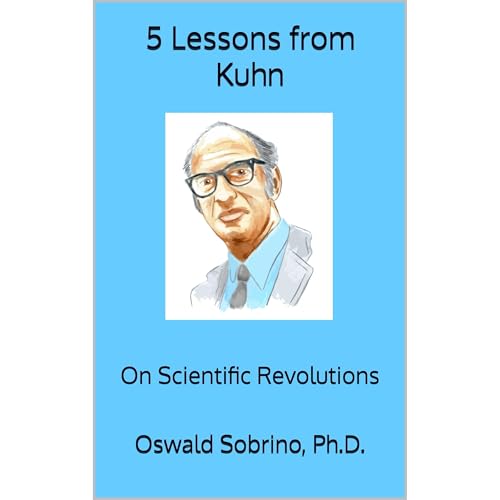
5 Lessons from Kuhn Audiolibro Por Oswald Sobrino arte de portada

5 Lessons from Kuhn

On Scientific Revolutions

Muestra de Voz Virtual

$0.00 por los primeros 30 días

Prueba por $0.00
Escucha audiolibros, podcasts y Audible Originals con Audible Plus por un precio mensual bajo.
Escucha en cualquier momento y en cualquier lugar en tus dispositivos con la aplicación gratuita Audible.
Los suscriptores por primera vez de Audible Plus obtienen su primer mes gratis. Cancela la suscripción en cualquier momento.

5 Lessons from Kuhn

De: Oswald Sobrino
Narrado por: Virtual Voice
Prueba por $0.00

$7.95 al mes después de 30 días. Cancela en cualquier momento.

Compra ahora por $3.99

Compra ahora por $3.99

OFERTA POR TIEMPO LIMITADO | Obtén 3 meses por US$0.99 al mes

$14.95/mes despues- se aplican términos.
Background images

Este título utiliza narración de voz virtual

Voz Virtual es una narración generada por computadora para audiolibros..
Thomas S. Kuhn (1922 to 1996), who finished his academic career at MIT, wrote one of the great works of the twentieth century entitled The Structure of Scientific Revolutions published in 1962. This major work made the word "paradigm" and the phrase "paradigm shift" part of our common language. He sought to explain as both an historian of science and as a philosopher of science how scientific communities advance their research agendas under a shared paradigm or exemplar until the discovery of anomalies lead to a crisis which is eventually resolved when a new paradigm arises. Newton and Einstein immediately come to mind from the field of physics. But there have been many other, less famous paradigm shifts in fields like chemistry, optics, and electricity. There can even be paradigm shifts in specialties that are little known to the average, educated person. The process described by Kuhn is a mixture of science, technology, sociology, and luck. Kuhn gives us a fascinating perspective on the world of science through time, and his perspective has influenced those in the social sciences and in the humanities as they consider the history and future of their own fields of inquiry. What may be the most fascinating is to see how individual scientists made the leap to a new paradigm when the old one could no longer provide needed explanations. This process is a riveting story about the human pursuit of greater and greater knowledge about the world.
Todavía no hay opiniones
