

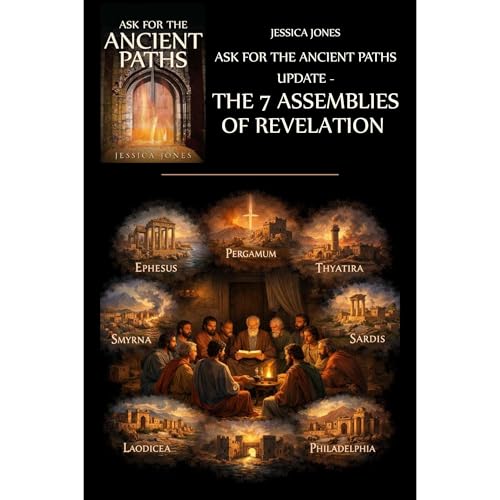
Ask For The Ancient Paths Update
7 Assemblies of Revelation
No se pudo agregar al carrito
Add to Cart failed.
Error al Agregar a Lista de Deseos.
Error al eliminar de la lista de deseos.
Error al añadir a tu biblioteca
Error al seguir el podcast
Error al dejar de seguir el podcast
Prueba gratis de 30 días de Audible Standard

Ask For The Ancient Paths Update
Compra ahora por $14.99
-
Narrado por:
-
Virtual Voice
-
De:
-
Jessica Jones

Este título utiliza narración de voz virtual
The seven assemblies of Revelation are rarely read as they are written.
They are reduced to church slogans, prophecy charts, or warnings aimed at other people.
This book rejects those approaches entirely.
The Seven Assemblies presents the assemblies as the unfolding ages of man, beginning with Adam and culminating in the reign of Yahshua — where Laodicea stands as the final Threshing Floor, separating wheat from chaff under His authority and rule with a rod of iron.
This is not a symbolic study divorced from history.
Each assembly is examined through:
its actual city,
its people,
its culture,
and its spiritual posture.
What Yahshua praises, what He confronts, and what He condemns are read as diagnosis, not metaphor.
Each assembly reveals a recurring pattern: man begins in humility, is corrected, resists correction, and eventually replaces obedience to YAHOVAH with confidence in self. Pride hardens. Blindness sets in. Faith becomes institutional, performative, or narcissistic — until judgment replaces reform.
Laodicea is not treated as a lukewarm cliché.
It is revealed as the final exposure — where self-sufficiency collapses, illusion is stripped away, and authority is removed from man entirely.
This book also integrates the prophetic framework of Nebuchadnezzar’s statue in the book of Daniel, showing how the kingdoms of men, the assemblies, and human rebellion move together through history toward the same conclusion. The assemblies do not exist apart from world empires; they mirror them.
This is not a gentle book.
It confronts:
institutional religion,
spiritual pride,
counterfeit authority,
self-worship disguised as faith,
and the refusal of correction that defines every fallen age.
The seven assemblies are not tools for judging others.
They are a mirror held to mankind itself.
This volume is written as a continuation of Ask for the Ancient Paths, expanding its foundation and applying it across history. It does not comfort institutions. It does not excuse churches. It does not soften Yahshua’s words.
Judgment is not presented as future speculation, but as an active process already revealed in Scripture.
This book is for readers who understand that healing only follows exposure, that deliverance requires confrontation, and that restoration cannot occur without repentance.
Those seeking reassurance, affirmation, or modern reinterpretations of faith should not read this book.
Those willing to stand on the threshing floor and be measured will recognize it immediately.