

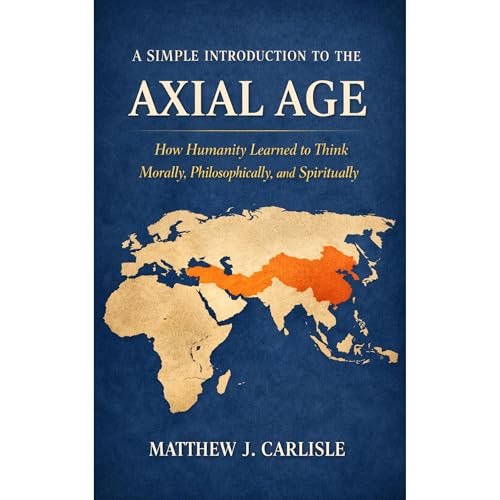
A Simple Introduction to the Axial Age
How Humanity Learned to Think Morally, Philosophically, and Spiritually
No se pudo agregar al carrito
Add to Cart failed.
Error al Agregar a Lista de Deseos.
Error al eliminar de la lista de deseos.
Error al añadir a tu biblioteca
Error al seguir el podcast
Error al dejar de seguir el podcast
Prueba gratis de 30 días de Audible Standard

A Simple Introduction to the Axial Age
Compra ahora por $9.99
-
Narrado por:
-
Virtual Voice

Este título utiliza narración de voz virtual
Something extraordinary happened between roughly 800 and 200 BCE.
Across the ancient world—often without direct contact—human beings began thinking in radically new ways about right and wrong, truth and illusion, suffering and meaning, and the inner life.
That moment changed everything.
A Simple Introduction to the Axial Age takes you inside the quiet revolution that reshaped how humanity understands morality, philosophy, and spirituality—and still shapes how you think today, whether you realize it or not.
This is the era that produced the Hebrew prophets, the Buddha, Confucius, Laozi, Socrates, Plato, Aristotle, and Zarathustra. It is the moment when ritual gave way to ethics, when power was challenged by conscience, and when humans first turned inward to examine the self. This book explains why it happened, how it unfolded across civilizations, and why it never went away.
Inside, you’ll discover:
- Why multiple civilizations experienced parallel moral and philosophical breakthroughs at the same time
- How conscience, self-examination, and universal ethics entered human thought
- The origins of ideas like justice, compassion, inner freedom, and moral responsibility
- How suffering became a problem to understand—not just a fate to endure
- Why ancient debates still shape modern politics, psychology, religion, and ethics
Written for curious readers rather than specialists, this book makes big ideas clear without oversimplifying them. It compares Greece, India, China, Israel, and Iran side by side, showing both shared patterns and crucial differences. You’ll see how Buddhism approached suffering, how Confucianism pursued harmony, how Greek philosophy elevated reason, and how prophetic traditions demanded justice—all as responses to a world under pressure.
This is not a dry academic survey. It is a guided tour of humanity’s first great intellectual awakening, told with clarity, momentum, and insight. You’ll come away understanding not just what the Axial Age was, but why it still matters every time you argue about values, meaning, or truth.
If you want to understand the ancient breakthrough behind modern thought—and see today’s moral and spiritual debates in a completely new light—this book belongs on your shelf.