

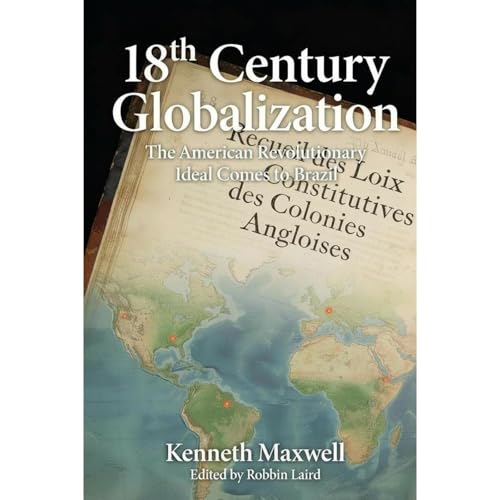
18th Century Globalization
The American Revolutionary Ideal Comes to Brazil
No se pudo agregar al carrito
Add to Cart failed.
Error al Agregar a Lista de Deseos.
Error al eliminar de la lista de deseos.
Error al añadir a tu biblioteca
Error al seguir el podcast
Error al dejar de seguir el podcast
Prueba gratis de 30 días de Audible Standard

18th Century Globalization
Compra ahora por $7.00
-
Narrado por:
-
Virtual Voice
-
De:
-
Kenneth Maxwell

Este título utiliza narración de voz virtual
Marking the 250th anniversary of the American Revolution, 18TH CENTURY GLOBALIZATION: THE AMERICAN REVOLUTIONARY IDEAL COMES TO BRAZIL shows how the American founding did not end at Philadelphia, but launched a wider Atlantic wave of republican experiments that reached deep into the Portuguese empire. Published in 2026, alongside a global outpouring of new work on 1776 and its legacies, Kenneth Maxwell’s study recovers one of the most surprising of those reverberations: a planned Brazilian republic in Minas Gerais in 1788–1789, directly inspired by a French-language collection of American constitutional documents first assembled as a propaganda tool by Benjamin Franklin.
At the heart of the book is the Recueil des Loix Constitutives, Franklin’s 1778 volume of translated American constitutions, which was crafted in Paris to convince Louis XVI’s ministers that the young United States possessed a coherent, exportable constitutional order and then repurposed, via pirated “Philadelphia” and “en Suisse” editions, as a revolutionary handbook in the mining towns of Vila Rica. Maxwell follows this single book from the salons of Auteuil and the foreign ministry of the Comte de Vergennes to the hands of Brazilian students educated at Coimbra, Montpellier, Bordeaux, and Birmingham, and finally into the conspiracy rooms of Minas elites who used the radical 1776 Pennsylvania constitution as a template for their own projected republic.
Drawing on decades of archival work in Brazil, Portugal, France, Britain, and the United States, the author reconstructs a dense Atlantic network of mediators, Franklin and Jefferson in Paris, Brazilian students such as Jos Joaquim Maia e Barbalho and Jos lvares Maciel, and Minas conspirators like Toms Antnio Gonzaga, Cláudio Manuel da Costa, and Tiradentes, who translated, misunderstood, and creatively adapted American texts to local conditions of debt, slavery, and imperial crisis. A detailed reading of the conspirators’ annotated copy of the Recueil, now preserved in the Museu da Inconfidência in Ouro Preto, allows Maxwell to show how a carefully curated script of American state-building was read “through a broken mirror” in Brazil, generating institutional plans more radical than anything Franklin intended even as the same men remained deeply enmeshed in a slave society.
Set against the broader Age of Revolutions and the commemorative moment of 2026, the book argues that the American Revolution functioned less as a closed national founding than as an Atlantic blueprint, one that circulated through universities, commercial ports, diplomatic channels, and secret trials from Versailles to Saint-Domingue and from Lisbon to Minas. Maxwell traces not only the Minas conspiracy and its brutal suppression, but also the long afterlife of these ideas, from Haiti and Brazilian independence debates to the twentieth-century rediscovery of the Recueil and the transformation of Tiradentes into a republican martyr honored every April 21.
As the fifth volume in the Portugal and Brazil Confront the Contemporary World series, 18TH CENTURY GLOBALIZATION speaks directly to the intense global reflection on 1776 at its 250-year mark while pointing readers toward a wider Lusophone and Atlantic scholarship that will be appearing in this anniversary year. It is essential reading for anyone interested in Atlantic history, Brazilian studies, American constitutionalism, or the unpredictable ways in which revolutionary blueprints are exported, bent, and turned into projects their authors never foresaw.